
What Packing Supplies Do You Actually Need? The Short List That Works
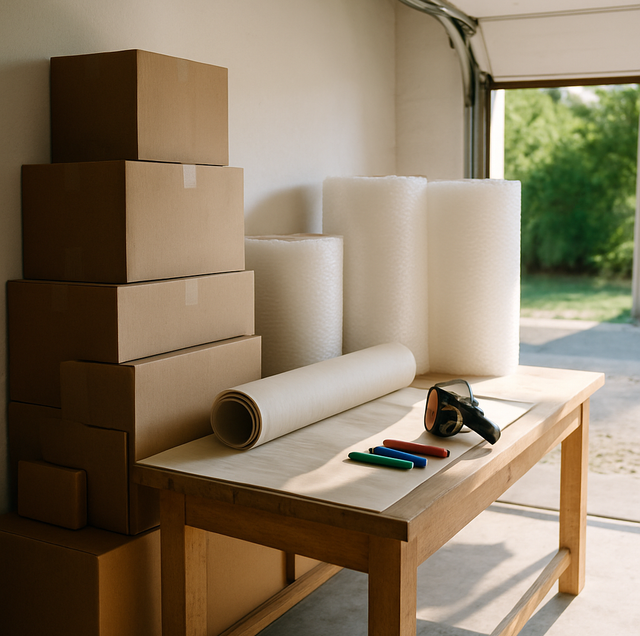
Walk into any hardware store aisle, and the packing section looks like it was designed to make you spend more than you need. Rolls of this, sheets of that, a dozen box sizes stacked to the ceiling. Most people either overbuy and end up with a garage full of leftover foam or underbuy and spend moving day taping a sagging carton back together. Neither is fun, and both cost you.
In practice, a good move runs on a surprisingly short list. Once you understand what each supply is actually doing, you can buy the right amount of the right thing and skip the rest.
Quick Answer: The core packing supplies for almost any household move are: sturdy moving boxes in a few sizes, packing paper and bubble wrap for fragile items, void fill for empty space, strong packing tape with a dispenser, furniture blankets and stretch wrap, plus markers, labels, mattress bags, and zip bags for hardware. A handful of specialty boxes rounds it out. Everything else is optional.
Why The Right Supply Actually Matters
Packing is not about wrapping things until they look protected. It is about controlling two forces: crushing weight from above and lateral movement. A box stacked at the bottom of a truck load carries the weight of everything above it, and that weight finds the weakest point. Empty space inside a box lets contents slide, tip, and knock together every time the truck turns or hits a bump.
Good supplies exist to fight those two forces. A double-walled box resists crushing. Void fill removes the empty space so nothing can shift. Tape holds the bottom seam closed so the load does not drop through. When any one of those fails, the damage is not gradual. A seam lets go, and a box of dishes hits the ground all at once.
Think of a packed box like a well-loaded backpack. If the heavy things sit low and tight and the gaps are filled, you can carry them across town. Toss everything in loosely with a brick rolling around the bottom, and the straps give out on the stairs. The same physics decides whether your belongings arrive whole.
That is also why cheap or free boxes fail so often. A carton that sat in a wet grocery-store back room has already lost half its strength, and mismatched sizes will not stack into a stable wall on the truck. The supply is doing real structural work, so it has to hold up.
The Boxes: General-Purpose Sizes
Boxes do most of the heavy lifting, and the trick is matching size to what goes inside. Three general-purpose sizes cover the bulk of a home.
- Small boxes are for heavy, dense things: books, canned goods, tools, and records. A small box keeps the total weight liftable even when the contents are heavy.
- Medium boxes are the all-purpose workhorse. Kitchen items, small appliances, toys, and the random contents of a hall closet all fit here.
- Large boxes are for light and bulky things: bedding, pillows, lampshades, and throw blankets. Big does not mean strong, so large boxes should stay light.
Buy more medium boxes than anything else, then small, then fewer large. Most people underestimate how many they need and end up on a second store run mid-pack.
The Boxes: Specialty Shapes That Earn Their Place
General-purpose boxes handle maybe eighty percent of a house. The rest have awkward shapes or fragile contents that a plain cube handles poorly, and that is where specialty boxes come in.
- Dish-pack boxes are thicker and built for kitchenware and glassware.
- Wardrobe boxes stand tall with a hanging bar inside so clothes hang on their hangers.
- Mirror and picture boxes are flat and adjustable for framed art and glass.
- Cell boxes use cardboard dividers to keep glasses and stemware apart.
You do not need many of these, but skipping them forces fragile or oddly shaped items into containers that cannot protect them.
Padding And Wrapping Materials
Boxes hold the shape; padding protects the contents inside.
- Packing paper (plain unprinted newsprint, not newspaper, which smudges ink onto everything) is the everyday wrap for dishes, glasses, and general cushioning.
- Bubble wrap goes around your most fragile pieces: electronics, ceramics, anything with a screen or a delicate finish.
- Packing peanuts and void fill go into the gaps so contents cannot shift. Crumpled paper does the same job in a pinch.
The goal with all three is a box that does not rattle when you gently shake it. If it moves, add fill.
Tape, Blankets, And The Rest Of The Kit
The small supplies are easy to forget and quietly essential.
- Strong packing tape with a dispenser- skip the thin bargain tape that curls and snaps. A dispenser cuts your sealing time roughly in half.
- Furniture blankets and pads wrap dressers, tables, and headboards so corners do not gouge walls or each other.
- Stretch wrap holds blankets in place and keeps drawers and cabinet doors from swinging open.
- Markers and labels turn a wall of identical brown boxes into an organized unload.
- Mattress bags keep beds clean and dry, which matters in a climate where a driveway can be wet any month of the year.
- Zip bags hold the screws, bolts, and small hardware from anything you disassemble, taped to the piece it came from.
Getting the Most From What You Buy
Having the right supplies is only half of it. How you use them decides the outcome.
- Heavy items go in small boxes, light items in large ones. This is the single most broken rule and the one that causes the most split cartons.
- Fill every void. A box packed to the top with no gaps resists crushing far better than a half-full one.
- Tape the bottom seams well before you load anything in. This is where failures start.
- Label by room and contents, not just "kitchen." Writing "kitchen: glasses, fragile" tells the person carrying it how to hold it and where it lands.
- Lift with your legs, not your back, and keep any single box light enough to carry without straining. A box you cannot lift safely is packed wrong, no matter how neatly.
What You Can Skip Or Substitute
Not every product on the store shelf earns a spot in your cart. Towels, blankets, and folded clothing make excellent free padding for dishes and cookware, and fill voids well, which cuts down on the paper and bubble wrap you buy. Dish soap boxes and thin liquor-store cartons are tempting, but they are inconsistent and weak. Specialty foam corners and edge protectors are worth it for a handful of high-value pieces and pointless for everything else.
Buy the supplies for structural work: real moving boxes, real tape, real padding for fragile items. Substitute soft household goods for the rest, and you will spend less while your belongings arrive in better shape.
Frequently Asked Questions
A small box of books stays liftable, while that same volume of books in a large box becomes too heavy for one person to carry safely and splits at the seams under its own weight. Box size is matched to weight, not just to how much space the items take up.
A dish-pack is a thicker, double-walled box, often fitted with cardboard cell dividers, that separates plates and glasses into their own compartments so they cannot knock against each other and crack while the truck is moving.
Yes, with two cautions. Avoid pressing colored or dyed fabrics, or ink-printed newspaper, directly against light upholstery or china, since the dye and ink can transfer and leave marks you cannot wash out. And remember, soft goods do not protect the corners of framed glass the way a proper box does; a folded towel cushions a flat face but leaves the vulnerable edges exposed. Treat linens as a supplement for cushioning and void fill, not a full replacement for boxes and wrap on the fragile pieces.
Mismatched sizes do not stack tightly and are often weak or slightly damp, so they shift and collapse under a load on the truck. Uniform moving boxes stack into a stable wall that carries weight evenly, which is why consistency matters more than saving a few dollars.
Plan for more than you expect to use, because running out mid-pack stalls everything. Tape the bottom seams in an H-pattern, running one strip down the center seam and one across each edge, so a fully loaded box will not burst open the moment it is lifted.
Wardrobe boxes and mirror or picture boxes are the two that pull their weight. Figure roughly one wardrobe box per two feet of closet rod, which keeps you from buying more than the closet holds. A telescoping mirror or picture box slides open to fit the exact frame, so the glass sits snug and does not rattle against the cardboard in transit. Ordinary boxes handle both jobs poorly, which is why these cost extra.
Get a hand from movers who pack it right the first time — so your belongings arrive whole. Butterfield Moving LLC serves Hillsboro, Beaverton, Portland. Call (503) 867-2414.