
Apartment Moving in Beaverton and Aloha: What Suburban Renters Should Know
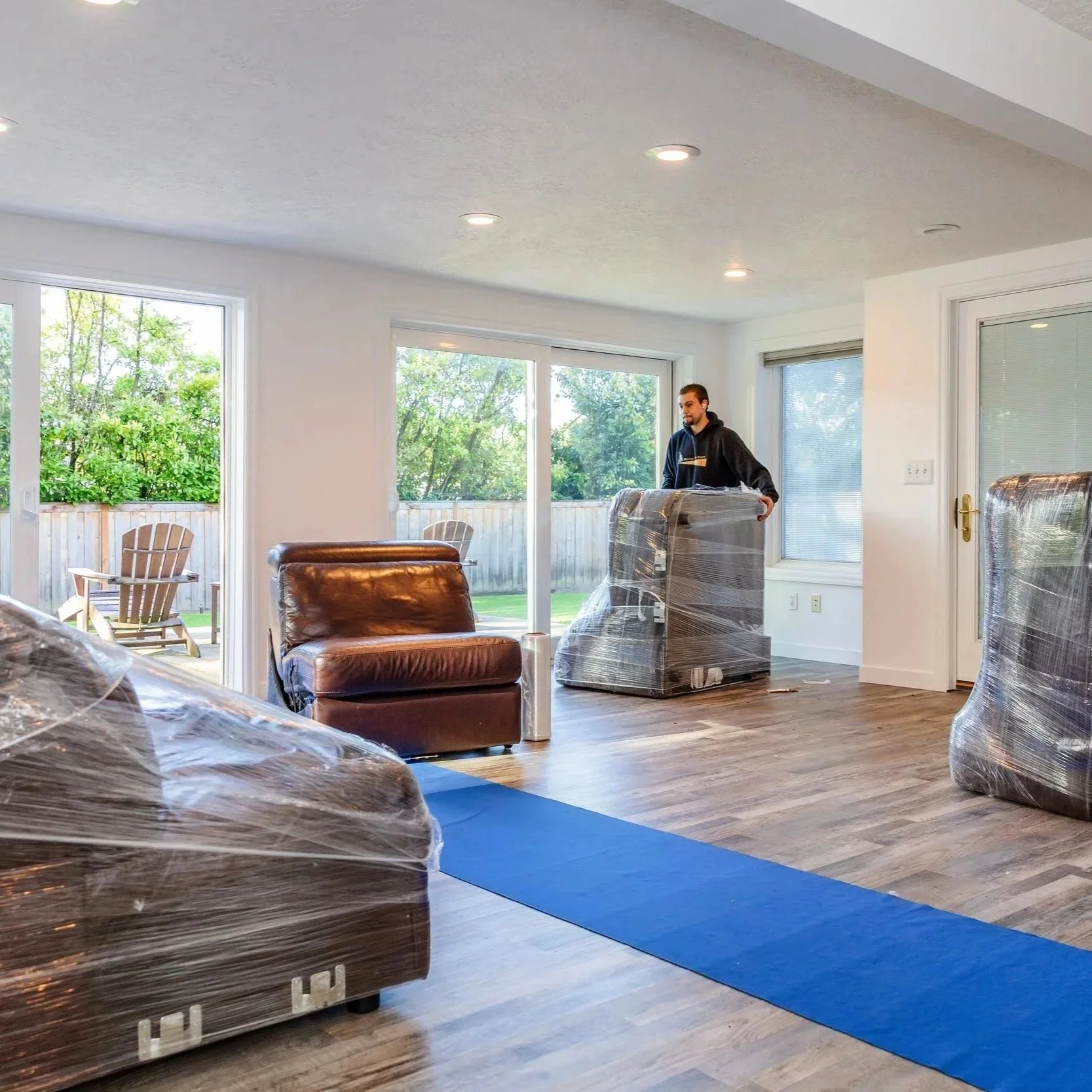
Professional movers carefully transport and protect furniture inside a bright modern home using protective wrapping and floor runners. The image highlights a clean, organized moving process designed to prevent damage during residential relocation and ensure a smooth, efficient move-in experience.
If you are renting an apartment in Beaverton or Aloha and planning a move, the natural assumption is that suburban moves are simpler than those in urban high-rises. They often are not. Many westside apartment complexes built since 2010 have move-day rules that look more like downtown high-rise rules than typical suburban ones. Service-elevator reservations. Certificates of insurance. Loading-zone scheduling. Move-in fees you did not see in the lease. The rules are known in advance, but most renters discover them on move day, when the front-desk staff says the elevator is unavailable without a $1 million COI from the moving company. Here is what to ask before you book the truck.
Suburban Apartments Are Not as Casual as They Look
Most renters expect suburban apartment moves to be simpler than urban high-rise moves. They often are not. Beaverton and Aloha apartment complexes built since 2010, particularly the larger 200+ unit complexes near Nike WHQ, in Tanasbourne, and along Tualatin Valley Highway, frequently have move-day rules that catch renters off guard. The rules exist for the same reasons they do in high-rises: shared elevators that affect every other resident, polished common-area floors, and building insurance liability that limits what the property owner covers when a tenant’s mover damages something.
The result for you: the rules apply even when your building is only 3 stories tall. The smaller scale does not change the building’s exposure.
What Beaverton and Aloha Complexes Typically Require
A common rule package shows up across most westside apartment complexes built or renovated in the last 15 years.
Move-in or move-out time windows. Common pattern: 8 am to 5 pm on weekdays. Some complexes prohibit Saturday moves entirely; others allow them with property-management approval. Sunday moves are often blocked.
Service-elevator reservation for buildings with elevators (3+ stories). The reservation is typically made through the property management office, often 1 to 2 weeks before your move date. Walk-in reservations on move day rarely work in larger complexes.
Loading-zone or designated moving-spot parking. Some complexes have a single moving spot that all residents share. Others have a designated dock where the moving truck has to back in. Most do not allow moving trucks in regular resident parking.
Certificate of insurance from the moving company naming the property management as additional insured. Larger complexes typically require general liability coverage of at least $1 million.
Floor protection requirements for common-area carpet and lobby floors. Some complexes provide floor runners and require their use; some require the mover to bring runners.
Move-in or move-out fees, sometimes $100 to $500. The fee is usually charged to your account, not the mover’s.
Different complexes have different combinations of these rules. The only reliable approach is to ask the property management office for the move-day requirements in writing, with enough time to lock down everything before move day.
How a Certificate of Insurance Works for Apartment Moves
For renters who have not encountered a COI before, here is how it works.
A COI is a one-page document from the mover’s insurance carrier listing coverage levels and naming the property management or building owner as additional insured. The “additional insured” piece is what most renters do not know about. A mover’s general insurance policy is not enough; the certificate must specifically list your apartment complex as a covered party.
Westside apartment complexes typically require general liability coverage of at least $1 million per occurrence. Some require $2 million for larger buildings. Workers’ compensation coverage for the crew is usually required as well.
The mover usually needs 1 to 2 business days to produce the COI. Last-minute requests sometimes get handled faster, but the safe assumption is to request the COI 1 to 2 weeks before move day.
DIY moves with a U-Haul and friends do not have COIs and often cannot use the building’s loading dock or service elevator. Some westside complexes will block the move entirely without a COI. If you are planning a DIY move and your complex requires a COI, the math changes — you may need to hire a mover specifically to satisfy the building requirement, even if you would otherwise have done the move yourself.
Why Some Apartments Restrict Weekend Moves
Common pattern across the westside, especially newer complexes.
Many complexes prohibit Saturday or Sunday moves to protect residents' quiet hours. Apartment complexes near Nike WHQ and along Highway 26 often have weekend restrictions. Others allow weekend moves only with property-management approval and additional fees.
Sunday moves are restricted at most westside complexes. Sunday is also the day when most movers charge overtime rates. Even when a complex allows Sunday moves, the cost is usually higher than on a weekday.
This concentrates apartment moves into weekday windows, which means weekday booking competition is higher than at single-family homes. Tuesday and Wednesday tend to be the most available days; Mondays and Fridays book up faster because they are the start and end of the work week. Plan your move-day request accordingly.
Costs of an Apartment Move in Beaverton or Aloha
Realistic ranges for what your move will cost.
Industry hourly rates Portland metro: $120 to $160 per hour for 2-to-3-person crews. Butterfield Moving publishes its rate at $146.95 per hour with a 3-hour minimum.
A typical Beaverton or Aloha 1-bedroom apartment move runs 3 to 4 hours, $400 to $700.
A typical 2-bedroom apartment move runs 4 to 5 hours, $600 to $1,200.
Add $100 to $200 for elevator wait time and long carry from the loading zone in larger complexes. Apartment complexes with multiple buildings or longer paths from the parking lot to your unit add real time to the move.
Pre-pack everything yourself to keep costs down; full-service packing for a 1-to 2-bedroom apartment adds $300 to $900, depending on contents. Many westside renters opt for partial packing — kitchen and fragile items handled by the crew, bedrooms and clothes packed by the renter — at a midpoint cost of $200 to $500.
If your apartment complex charges a move-in or move-out fee ($100 to $500 is typical), that fee is on top of the moving cost and is paid to the property management, not the mover.
Verifying Rules Before Move Day
A practical checklist for renters in Westside apartment complexes.
Email or call the property management office and ask for the move-in or move-out rules in writing. The phrase “in writing” matters. Verbal commitments don't go far when the on-duty front desk staff is different on move day.
Confirm the COI requirements. Get the carrier names, coverage limits, and the exact additional-insured language the property management requires. Send this to your mover so they can issue a complete COI in one pass rather than going back for revisions.
Reserve the service elevator or loading dock 1 to 2 weeks in advance. Some complexes have a single dock that all residents share. If another resident has the spot booked for your window, your move waits.
Verify the time window the complex allows for moves and any premiums or restrictions on weekends. If the complex restricts Saturday moves, lock in a weekday before peak season makes weekdays scarce.
Verify any move-related fees the complex charges you. Some complexes charge $100 to $500 for moves; others do not. The fee is usually deducted from your security deposit at lease end if not paid upfront.
Confirm what protection materials the complex provides versus what the mover has to bring. Some complexes provide floor runners and elevator pads; some require the mover to bring everything.
Common Westside Complex Patterns Without Naming Names
Some real patterns without specific complex names.
Newer complexes near the Nike WHQ area and Tualatin Valley Highway often have stricter rules than older complexes around Beaverton Central. The newer the complex, the more likely it is to require COIs, dock reservations, and time-window restrictions.
Apartments and condos near the Beaverton/Hillsboro MAX line frequently have dock reservations because units sit above ground-floor retail. The retail and residential tenants share loading access, so scheduling matters.
Tanasbourne complexes often have move-day restrictions, especially the larger 300+ unit communities. These were built with apartment-complex management standards similar to urban buildings.
Older Aloha apartments tend to have looser rules, but smaller loading zones and tighter elevator stops. Your truck may not fit close to the door, and the elevator may not fit a king-size mattress in one piece.
These patterns help you know what to ask about. The specifics for your complex come from the property management office, not from generic information online.
When the Move Is Up Against the Lease End
Tight timing reality for westside apartment moves.
Most Beaverton and Aloha leases turn over at the end of the month. Move-out and move-in concentrate on the last few days and the first 1 to 2 days of each month. Loading docks book up. Service elevators run on a schedule. The first three days of the month are the hardest in any westside apartment complex, and the most competitive for movers.
Booking 4 to 6 weeks ahead for an end-of-month move is normal in peak season; 2 to 3 weeks ahead is sometimes enough off-peak. If your lease ends on the last day of the month and you want a same-day move, lock in your moving crew as soon as the new lease is signed. Waiting 2 weeks costs you the best dates.
If your lease end and new-lease start do not line up perfectly, you have two options. Pay overlap rent for a few days to cover the move (often the cheapest answer for short gaps). Use storage and a hotel for longer gaps (more expensive but more flexible).
Frequently Asked Questions
Not all, but most of the larger complexes built since 2010 do. Smaller and older complexes often have looser rules. The only way to know is to ask the property management office in writing. Even when a COI is not required, many westside complexes still want a copy of the mover’s insurance certificate on file before move day.
A 1-bedroom apartment move typically runs 3 to 4 hours at industry rates of $120 to $160 per hour, totaling $400 to $700. A 2-bedroom apartment move runs 4 to 5 hours, $600 to $1,200. Add $100 to $200 for elevator wait time and long carry in larger complexes. Add $100 to $500 if your complex charges a move-in or move-out fee.
Some complexes allow Sunday moves, some do not. Sunday moves typically trigger overtime rates from movers regardless of the complex policy. Even when both the complex and the mover allow Sunday work, expect a higher hourly rate than on a weekday. Verify with property management in writing before booking the mover.
In most larger westside complexes, your move cannot start without a service-elevator reservation. The freight elevator may be in use by another resident’s move, by a delivery, or by maintenance. Your truck waits. The crew waits. If you are paying hourly, the clock runs. Smaller complexes are sometimes more flexible, but the safe assumption is that a reservation is required.
The renter. Move-in and move-out fees are charged by the property management to the resident’s account, not to the moving company. Some complexes deduct the fee from the security deposit at lease end; some require upfront payment. Either way, the fee is your responsibility, not the mover’s.
For end-of-month moves in peak season (May through September), book 4 to 6 weeks ahead. For off-peak weekday moves, 2 to 3 weeks ahead is often enough. The specific lead time depends on your move date — Saturdays and end-of-month days book up first.
Westside apartment moves are not as casual as the suburban setting suggests. The rules are knowable, and the moves run smoothly when the rules are confirmed in writing 1 to 2 weeks before move day. Ask property management for the COI requirements, the elevator reservation process, the time window, the fees, and the protection requirements. Bring that list to your mover. The actual move day runs better when the paperwork is in order than when everyone is figuring it out at 9 am with the truck idling in the dock.
Moving into or out of a Beaverton or Aloha apartment? Butterfield Moving handles westside apartment moves with the proper insurance documentation and complex-specific coordination. Call (503) 506-4149 to schedule a free estimate at $146.95 per hour with a 3-hour minimum.