
How to Protect Floors and Walls During a Move
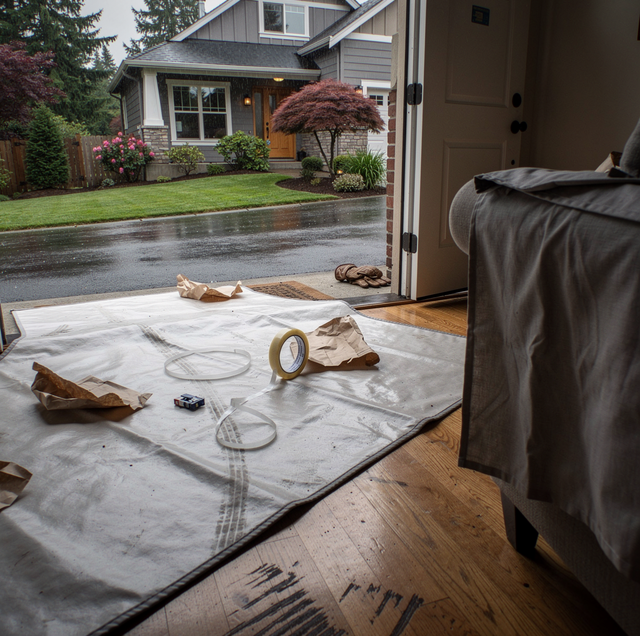
How Floors And Walls Actually Get Damaged On Move Day
Most damage on move day doesn't come from one dramatic accident. It builds up from a dozen small, forgettable moments: a dresser dragged three feet because carrying it felt like overkill, a box corner clipping a doorframe on the way past, a hand truck wheel rolling over the same stretch of hardwood a few too many times. None of it looks like much in isolation, but by the end of a long day those small moments add up to gouges in the flooring and dented corners on every wall between the truck and the front door.
Dragging is the biggest offender. Furniture legs and box edges have no give, and a floor finish has very little either, so pulling a couch across a room instead of lifting it turns a smooth surface into a track of scuff marks in seconds. Dropped boxes come next, especially ones packed heavier than they look, since a sharp corner hitting a hard floor from even a foot up can chip tile or dent hardwood. Door frames take a beating from anything wide passed through at an angle: a mattress, a headboard, a bookshelf on its side. And a dolly or hand truck, useful as it is for getting heavy items where they need to go, wears a groove into carpet or scuffs a hard floor every time its wheels roll over the same path loaded down with weight.
None of this means the day has to end with visible marks everywhere. It means those four causes are worth planning around before anyone starts carrying anything.
Protective Materials That Make The Biggest Difference
A handful of inexpensive materials handle almost every risk above, and none of them require special skill to use correctly.
Floor runners, sometimes sold as Ram Board or builder's paper, roll out along the main path furniture will travel and are taped down at the seams so they don't slide underfoot. They protect hardwood, tile, and even some carpet from scuffs, dropped items, and the repeated wear of foot traffic and rolling equipment. For a move with any real volume, running this material from the front door to the truck before anyone lifts a single box pays for itself many times over.
Furniture blankets do double duty. Wrapped around a dresser, table, or bookshelf, they cushion the piece itself against dings, but they also act as a buffer between furniture and any wall or doorframe it brushes against in transit. Corner guards, which are small foam or cardboard caps that slip over sharp table and cabinet corners, prevent those corners from gouging a wall or another piece of furniture during a tight pass through a hallway.
Door jamb protectors are the piece most people skip and then regret. These are simple foam or plastic covers that snap onto the edges and corners of a door frame, taking the hit instead of the wood trim when a couch arm or dresser edge swings a little wide as it goes through. A door frame is also one of the more expensive things to repair well, since matching trim paint and finish isn't a quick fix, which makes the few minutes it takes to cover the frames worth it on almost any move.
Between floor runners, blankets, corner guards, and jamb protectors, the vast majority of contact points a move creates are covered before the first heavy item leaves the room.
Planning Furniture Routes Before Anyone Starts Lifting
Protective materials handle the surfaces. Planning the route accounts for turns, and turns are where most collisions occur. Walking through the space before moving day, with an eye specifically on how the largest pieces will travel from their current spot to the truck, catches the tight corners and narrow doorways before they turn into a stuck couch or a scraped wall.
Start by identifying the widest and most awkward items: a sectional, a large dresser, a dining table, a bed frame. For each one, trace the actual path it needs to take, measuring doorway widths and hallway turns against the item's dimensions rather than guessing. A piece that clears a doorway straight on may not clear it at an angle, and a hallway that looks wide enough can still force a piece into a wall if there's a turn partway through.
Where a tight squeeze is unavoidable, plan for it rather than discovering it mid-lift. That might mean temporarily removing a door from its hinges to gain a few extra inches, taking legs off a table or couch before moving it, or simply deciding in advance that a piece goes out through a different exit than the main flow of boxes and furniture. Assigning two people to any large piece for the entire route, rather than one person carrying and hoping for the best, also cuts down on the moment-to-moment misjudgment that leads to a dropped corner or a hard bump against a frame.
A few minutes spent walking the route and talking through it with anyone helping is far cheaper than the time and cost of patching a wall or refinishing a section of floor afterward.
Checking For Damage After The Move
Even with every precaution taken, it's worth a quick walkthrough once the truck is empty and the furniture is roughly in place. Check baseboards and door frames for fresh scuffs or dents, since these appear as lighter scrapes on painted surfaces or small dents where a sharp corner has made contact. Look along the main path items traveled for scratches in hardwood or tile, particularly near doorways and any spot where the route required a turn.
Carpet is worth checking for flattened or torn patches where a dolly or heavy furniture sat or rolled repeatedly, and walls are worth a look at roughly furniture height, since that's where a dresser or bookshelf edge is most likely to have made contact while being carried past. Corners of rooms and the tops of stairwells deserve a second glance too, since both are common spots for a wide item to catch on the way through.
If something does turn up, a small scuff on a hard floor can often be buffed out with a bit of floor polish or a magic eraser depending on the finish, while a scrape in a painted wall is usually a light sanding and a touch-up with matching paint. Anything deeper, like a gouge that's gone through a floor's finish layer or a dent that's cracked the drywall underneath, is worth photographing right away and addressing with whoever helped with the move while the details are still fresh, rather than waiting weeks and trying to remember exactly how it happened.
Frequently Asked Questions
Laying down floor runners or builder's paper along the path furniture and boxes will travel is the one step that prevents the widest range of damage, since it covers scuffs, drops, and the repeated wear of dollies and foot traffic all at once. Taping the seams down so the material doesn't shift underfoot makes it work as intended for the whole day.
For any doorway that's truly tight against a large piece of furniture, temporarily removing the door is a quick fix that gains a few extra inches and removes one more surface that could get scraped. It only takes a few minutes with a basic screwdriver or hinge pin, and it's far faster than dealing with a stuck piece of furniture mid-move.
Distance doesn't reduce the risk of a dresser edge brushing a wall or a table corner catching a doorframe, since that risk comes from tight turns and narrow passages rather than how far the truck has to drive. Wrapping large pieces in blankets is worth doing even for a move across town.
A layer of ram board or thick moving paper taped over the carpet in the main path prevents both flattening and tearing from repeated wheeled traffic. For an especially heavy or long haul across carpet, plywood sheets laid end to end give the wheels a firm, flat surface instead of sinking into the pile.
Photograph it as soon as it's noticed, before furniture gets rearranged again, so there's a clear record of the mark and its location. A light scuff can often be treated with a floor-appropriate polish or cleaner, while anything deeper is worth having assessed before deciding on a repair.
Foam and plastic corner guards hold up well through multiple moves as long as they aren't torn or crushed, and keeping a set on hand, along with furniture blankets, means the next move starts with protective materials already in place rather than a last-minute supply run.
Planning a move and want the walls and floors to look the same afterward — Get a crew that shows up with furniture blankets, floor protection, and a plan for every tight turn in the house. Butterfield Moving LLC serves Hillsboro, Beaverton, and Portland. Call (503) 867-2414.