
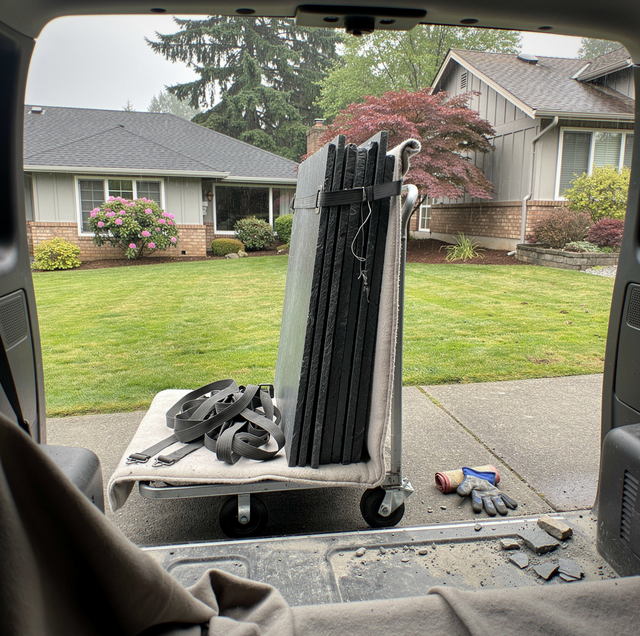
A slate pool table does not move the way a dresser or a sofa does, because the part that makes the game play true is a slab of natural stone, heavy enough to injure someone who tries to carry it the wrong way and brittle enough to crack if it flexes or takes weight unevenly across its own edges. On a regulation-size table, that slab is split into head, center, and foot sections that bolt to a wooden frame and to each other at the seams; a smaller or older table can carry the slab in one piece instead. Either way, the table comes apart before any of it travels, and the order in which disassembly occurs determines whether the pieces arrive ready to play or as a repair job.
Here is how each part of the table separates from the others, the way it travels, and who picks up the work once it lands at the new address:
| Part | How It Travels | After Delivery |
|---|---|---|
| Rails and pockets | Unbolted from the frame, labeled by position, wrapped flat | Bolted back on by the billiards technician after the slate is leveled |
| Slate (one section or several) | Padded, stood on edge and strapped, never carried flat | Set level across the seams and finished by the billiards technician |
| Frame (cabinet) and legs | Separated at the leg bolts where the legs unbolt, padded, carried upright | Assembled and leveled by the billiards technician |
| Bolts, washers and shims | Bagged and labeled by section | Matched back to their rail, leg or slate section by the technician |
| Cloth | Rail cloth stays on the rails; the bed cloth is unstapled from the slate and folded | Reused or replaced, at the technician's and your call |
Taking the Rails and Pockets Off and Labeling Them
The rails, the side and end pieces that carry the cushions, and the pockets come off first. The bolts that hold a rail to the frame sit underneath it, reached from below the apron or through the open pocket, rather than on top, where they would be easy to spot. As each rail comes free, it gets labeled for its position, head rail, foot rail, or one of the two side rails, and is set aside wrapped flat instead of leaned on an edge that can chip. Where the pocket mounts to the rail, it stays with that rail, so a labeled rail keeps its pocket paired without an extra step. Skip the labeling and the reassembly turns into matching four nearly identical rails against four nearly identical openings by trial and error. A table is never lifted by its rails or legs either, since both are bolted on and not built to support the bed's weight.
On some tables the pocket leathers are stapled to the slate's wood backing rather than fastened to the rail; those come off before the slate lifts and travel labeled for their corner, so a rail can leave without its pocket.
Lifting the Slate Out and Why It Rides Vertical and Padded
Once the rails are clear and the bed cloth is off, the screws holding each section to the frame come out, and the slate is next: this is the step where the table stops being furniture and starts being handled like stone. A slab that size is built to carry weight resting flat on a solid frame, spread evenly across its whole underside. Pick it up and support it at only a few points, and it can crack under its own weight instead of the load it was built to hold. That is why the slate never rides flat: it goes out padded and stood on edge, carried close to vertical, and braced so the load runs down through its edge rather than across an unsupported middle. Each section moves on its own; nobody carries two sections stacked or leaned against each other, because a corner catching a corner is how a slab chips in transit.
A slate section is heavy enough to injure someone if it slips or tips outside the frame; the crew moves it with its own straps and dollies, and children and pets belong outside the room until it is back.
The Frame, Legs and Hardware Bags
With the rails and slate clear, what is left is the frame, sometimes called the cabinet, and its legs. On tables whose legs unbolt, they come off at their own bolts from inside the frame, and each leg gets padded and carried upright rather than dragged on its foot, since a foot is built to bear weight straight down, not to slide across a floor. Every bolt, washer, and leveling shim that comes off any part of the table goes into a bag labeled for the piece it belongs to: rails in one bag, legs in another, slate screws and shims in a third. A mixed bag of identical-looking bolts is what turns an easy reassembly into a guessing game at the other end.
Clearing the Path from the Game Room to the Truck
A slate section and a padded frame still have to get from wherever the table stood to the truck, and that means doorways, turns, and possibly a staircase, the same obstacles any large piece runs into on moving day. Measure that route the same way you would for any large piece before moving day, because a slate section cannot twist through a tight turn the way a padded, flexible piece can. The same floor and wall protection used on moving day protects the path while the frame and slate move through it, since a heavy, awkward load is exactly what scuffs a floor or catches a doorframe if nothing is down first.
Where the Handoff to the Billiards Technician Starts
The crew's job ends in the room where the table lands. The crew sets the frame and its legs in the room, and leaves the slate sections, rails, and hardware bags exactly where the technician will want them, but the crew does not level the frame, does not finish the seams between slate sections, and does not lay or stretch new cloth. Getting a table to play true again is precision work, filling and leveling the seams across the whole bed before the cloth goes back down, and that is a different trade with different tools. The labeling done when the rails came off is what lets that handoff happen without guesswork: a rail marked for its position and a bag of hardware tied to the right leg means the technician spends time leveling and finishing the table, not figuring out which bolt goes where.
Getting the Room Ready at the New House Before Delivery
The room at the new address is worth setting up before the truck backs in. Clear the floor where the table will sit down to bare, level flooring, not just an open path to it, because the frame gets stood up and the slate gets set down in that spot, not carried through the house a second time once it is off the truck. Decide the table's final position before delivery day rather than after, since moving a reassembled table later means moving stone again. If the floor is carpet, a firm, flat surface under the frame's feet can keep the legs from settling unevenly while the table waits for the technician. The space to clear is the assembled table's footprint plus room around it for someone to kneel and work the seams.
Frequently Asked Questions
No. A one-piece bed, found on some bar-size and antique tables, travels strapped to a rigid board and stood on edge, so the board supports the slab along its whole face.
Each section is shimmed and screwed down level to the frame, with alignment pins on some tables, and only then is the seam filled flush. The fill closes the joint; the shimming is what keeps the sections level with each other.
The rail cloth stays on the rails. The bed cloth is stapled to the wood backing on the slate, or glued on some tables, so it comes off before the slate does; whether it goes back on or new cloth replaces it is decided with the technician at reassembly.
It depends on the table. Some frames have legs that unbolt from inside the cabinet; others use a frame and legs built as a single fixed unit, so the whole cabinet travels upright as a single piece rather than leg-by-leg removal.
It changes what comes out from under the table. A drop pocket holds each ball where it falls. A ball-return table adds a track and gully boxes fastened under the frame that roll each ball to a collection box. The track comes out and travels with the table's hardware, since the technician rebuilds the return path from those exact pieces.
No. The billiards technician's appointment can be scheduled for a later date. Until then, a slate section lying flat on padding across a level floor is supported along its entire face and has nothing to tip over, while one leaned loose against a wall rests its weight on a single edge.
Reserve heavy-item moving for your slate pool table as part of your move — the crew takes the table apart for travel, carries each slate section on edge, and sets every labeled piece in the room for your billiards technician. Butterfield Moving LLC serves Hillsboro, Beaverton, and Portland. Call (503) 867-2414.