
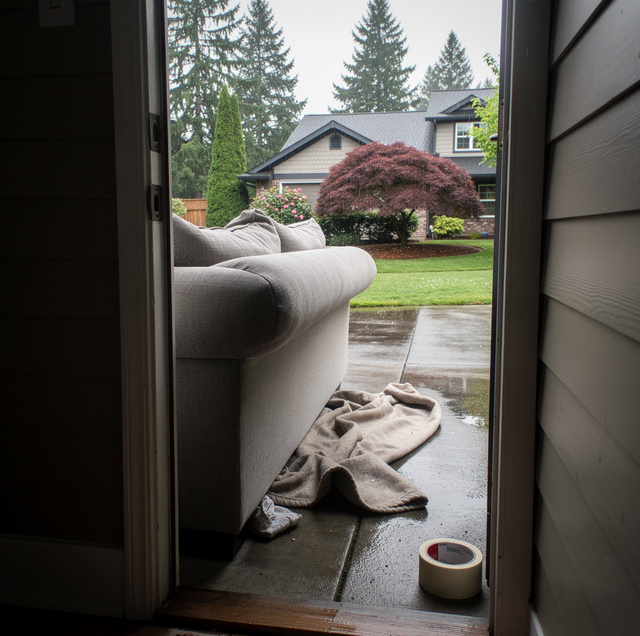
A sofa that looks jammed against a doorway from across the room is not blocked by its length. The number that determines whether it clears in one piece is the smallest of its depth, height, and diagonal depth. A long sofa can pass through a narrow opening when standing at one end; a boxy one with a tall back and a deep seat can stall in the same doorway when all three figures exceed the opening. Once you know which measurement is blocking the piece, you know whether the fix is a technique, something that comes off the sofa, or something that comes off the doorway, and in what order to try them.
The steps escalate from least invasive to most invasive, and the table compares each one with when it applies and what it takes to do.
| Step | When It Applies | What It Involves |
|---|---|---|
| Standing the sofa on end and hooking it through | The smallest of the sofa's depth, height, and diagonal depth is narrower than the doorway, and the piece has to turn to present it | Tipping the piece onto one arm, angling the leading top corner into the opening first, then walking it forward while pivoting the trailing end in behind it |
| Removing legs, feet and loose cushions | The smallest measurement is close to the doorway's width but not clear of it, and the legs or cushions add just enough bulk to block it | Unscrewing or unclipping legs and feet, and pulling every loose or removable cushion off before the lift |
| Taking the door off its hinges | The sofa's corner catches on the open door or its hinge side rather than on the jamb | Lifting the door off its hinge pins and setting it aside for the carry, then rehanging it once the piece is through |
| Separating a sectional at its connectors | The piece is a sectional and one section alone still will not clear the frame | Disconnecting the sections at their built-in connectors and carrying each section through on its own |
| Removing a recliner's back or a sleeper's mechanism where it is built to come apart | The piece is a recliner or sleeper sofa designed with a back panel or mechanism that detaches from the frame | Releasing the panel or mechanism at the points the frame was built to separate, then carrying the pieces through individually |
| Removing a storm door or trim | An exterior storm door or a run of interior trim is narrowing the opening beyond the door itself | Taking off the storm door or the offending trim piece, without touching the wall or the frame underneath it |
| Another route | Every interior option is exhausted and another opening, a sliding door or a second exterior door, offers room | Carrying the piece through that opening instead of forcing the original doorway |
The Depth, Height and Diagonal That Decide the Fit
Three measurements across the body of a sofa determine whether it fits through a doorway. Width across the front of the sofa, its length, is the number the carrier works around by hooking, because nobody carries a couch through a door face-first. What has to clear the doorway's width is the smallest of the sofa's height, its depth, and its diagonal depth, the shortest distance from the bottom rear corner of the frame to a straight edge laid from the top of the back to the front of the arm, since the piece can be turned to present whichever of those is smallest. On a low-backed sofa that can be the height; on a sofa with a tall back and a deep seat, the diagonal depth can be the one figure that fits.
Measuring the route itself, how a hallway turns or where a staircase lands, is a separate problem from measuring the piece. Getting a sofa through a doorway is a fit problem resolved by the sofa's own measurements; the applicable step depends on how the smallest of its three dimensions compares with the doorway's width.
Hooking and Pivoting Through the Opening
Hooking a sofa through a tight doorway is a rotation problem. Standing the piece on one end makes its length upright and its depth span the opening. The leading top corner goes into the doorway first, and as it clears the frame, the carriers walk the sofa forward while pivoting the trailing bottom corner in behind it along the widest line the doorway allows. Two people work this from opposite ends: one guides the leading corner and sets the angle, keeping their back straight through the pivot rather than twisting under the load, while the other supports the trailing weight and keeps the piece from swinging wide as it turns. The hook follows the doorway's widest line rather than the shortest path across the room, which keeps the corners clear of the frame.
What Comes Off the Sofa
When hooking the piece through does not clear it, the next step is making the sofa smaller before touching the doorway at all. Legs and feet come off first, since legs attach with a bolt, a bracket, or a threaded post that backs out by hand or with a single tool, and removing them takes their length off the sofa's height. Loose seat and back cushions come off next; they add bulk without adding structure, so pulling every removable cushion strips weight and bulk from the piece with no loss of stability.
A sectional separates at the connectors built into its frame, the clips or brackets holding two sections together, so each section travels through the doorway on its own rather than as one long unit. A recliner or a power sofa is different: some models are built with a back panel or a mechanism designed to detach at built-in release points, and where that feature exists, it is worth using before any lift begins. Any piece with a motor or power controls gets unplugged before a hand goes near a moving part, because a mechanism that is still live can cycle while someone's fingers are inside it.
A sleeper sofa's fold-out mechanism can snap shut hard enough to crush fingers, so a moving crew locks it closed with a strap before the sofa is tipped onto its end, and keeps hands clear of the hinge until it is fastened.
What Comes Off the Doorway
If the sofa itself cannot shrink any further, the next place to look is the doorway. An interior door lifts off its hinge pins once the pins are tapped up and out, and removing it removes the door's thickness and its hinge side from the opening, which still stands in the way even with the door swung fully open. A storm door or a screen door on an exterior opening comes off the same way, and on some entries it is the storm door, not the main door, that was narrowing the frame all along. A run of interior trim, the casing nailed around the doorway, can sometimes be pried free if it is the piece catching the sofa's corner.
None of this touches the structure holding the opening in place. The door, the storm door and the trim all come off and go back on during the move; the wall studs, the header and the frame itself stay exactly where they are. Widening an opening by cutting into any of those is a different, much larger job, not a step in getting one sofa through a door.
When a Piece Cannot Pass Whole
Once the sofa is stripped to its frame and the doorway to its jambs and the piece still will not turn through, the piece came in another way, through a different opening or in parts assembled in the room, and the move switches to a different opening, leaving the frame and the upholstery whole.
Reassembly and Checking the Fit at the New Home
Reassembly runs in reverse, and the order matters for the same reason it mattered coming apart. Legs and feet go back on before the piece is set in its final spot, since a bolt or bracket under the sofa is within reach when the piece is tipped on its side and out of reach once it sits against a wall. A sectional's connectors reattach section by section, checking that each clip seats fully before the next section goes on, so the finished piece sits flush rather than gapped at the seam. A recliner or power sofa's mechanism reconnects at the same release points it came apart at, and any power cord is plugged back in and tested before the piece is loaded with cushions and pushed into place.
The door goes back on its hinges the same way it came off, pins dropped in from the top down, and a storm door or trim piece is reset and checked for square before the job is called finished. A short walk-through afterward, opening and closing the reinstalled door, sitting on the reassembled piece, cycling a reconnected recliner, catches a loose connector or a misaligned hinge while the crew is still at the house.
Frequently Asked Questions
Yes. A back cushion sewn or zipped to the frame stays on through the carry, so the depth and the diagonal depth are measured with it in place, and only the loose seat cushions come off before the lift.
A platform-style sofa built without separate legs skips that first step entirely, so the sequence moves straight from cushions to the doorway itself or to any connectors the piece has. There is nothing to unbolt on a frame that was built without a leg assembly.
It depends on the connectors. Where they are made for one seam, the sections go back in the order and orientation they came apart in; on a modular sectional built to be rearranged, the connectors match on every section, and the pieces can join in a new layout.
A storm door's closer arm mounts to its own frame, separate from the main entry door's hinges, so taking the storm door off does not affect how the main entry door hangs or swings once it goes back up. The two doors operate on entirely separate hardware.
Yes, when its height is narrower than the doorway. Laid on its back, the piece crosses the opening with its height across the doorway and its length traveling straight through, so no hooking turn is needed on a straight approach.
A removable back slides onto a bracket on each side of the seat, with a latch or lever on each bracket reached from behind, under the fabric flap at the back. A back with no brackets is fixed to the frame, and the recliner travels as a whole.
Retain a furniture moving crew for your residential move — leg, cushion, sectional-connector and door removal, with reassembly at the new home. Butterfield Moving LLC serves Hillsboro, Beaverton, and Portland. Call (503) 867-2414.