
What Makes a Move Run Late, and Where the Hours Really Go
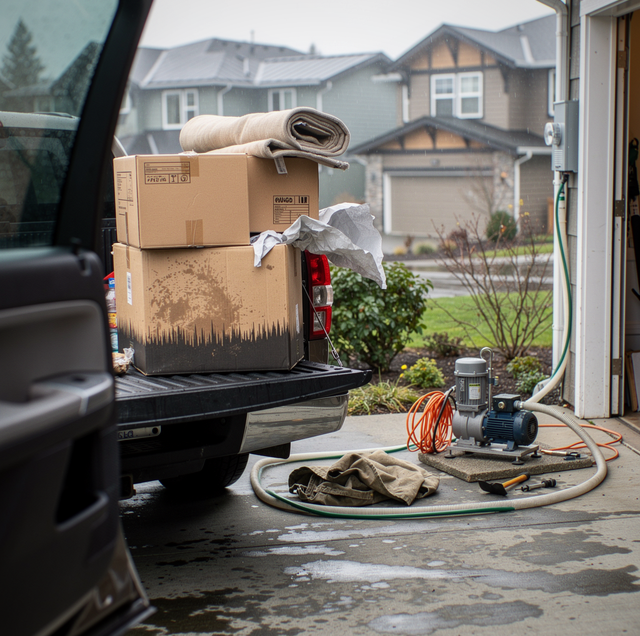
Two addresses fifteen minutes apart give you thirty minutes of driving on a day that runs eight or nine hours. The truck moves once. The rest of those hours happen with it standing still at a curb, while a crew walks the same short route out of your old door and in through your new one, several hundred times.
So when a move runs late, it happens at the two ends of the day. The walkthrough that stretches, the load that will not stack, the carton that stops at the threshold with nowhere to go: each of those traces back to a choice you made weeks earlier, and move day is where you find out which one.
Where the Hours in a Move Go
Set the driving aside and the day breaks into blocks. At the origin, there is a walkthrough, then a setup: runners down the traffic path, pads on the door jambs, the ramp out. Then disassembly. Then wrapping, four to six pads and a strap on a dresser. Then the carries. Then the tiering and strapping inside the truck. At the destination, the list runs backward, plus one block with no counterpart at the origin: placement, where every item needs a room, and some need reassembly.
Two of those blocks are fixed costs that happen twice. Laying and pulling floor protection is the same work whether your house holds twenty items or two hundred.
The rest is repetition, and repetition is where a small penalty stops being small. A few extra seconds on one trip is nothing. The same seconds across the hundreds of loaded trips a household takes is the gap between finishing in daylight and finishing under work lights. You sized every one of those blocks before move day, one decision at a time.
The Walkthrough Costs Ten Minutes or Ninety
A crew's first walk through your house is a planning pass. They are building a load order: what goes on first, which pieces need disassembly and which need pads, what is heavy, what is staying. A truck gets loaded in the reverse order things are needed, so the crew has to know the last item leaving your house before they can commit to the first item in.
When every room in your house has a clear answer, that pass takes about as long as it takes to walk the house. When it does not, it becomes a decision meeting held standing up with three people on the clock. The garage that never came up when you booked the move. The half-packed spare room where the crew cannot tell what is finished.
None of that was created that morning. Two earlier choices made it. The first is the inventory you gave at booking, which set the truck size and the crew size; an attic or garage left off it means the day runs on the wrong numbers. The second is the date you set aside for sorting. If that date slipped, the sorting now happens with a crew in the room, at the pace of the slowest decision.
The Load Is Built in Tiers, and Loose Items Break Them
Inside the box of a truck, a load goes up in tiers: cartons floor to ceiling across the width, squared and strapped, then the next tier set against it. Tiers hold because their pieces are regular: sealed cartons with flat tops in two or three sizes stack square and carry weight above them, and padded, squared furniture does the same.
What breaks a tier is anything without a flat top and a fixed shape. An open carton. A laundry basket mounded over the rim. A table with its legs on, which can only sit one way. Each of those either gets handled at the tailgate or gets set loose into a gap, and a gap is space carrying nothing.
That is the quiet expense, because space decides whether your load makes one trip or two. A truck that fills before the house empties turns one drive into three: back empty, a second load, a second unload. That adds a return drive, a second full load and a second full unload to a day quoted for one of each, and it is settled by how much air went into the truck early.
The choices behind it are older than the morning: whether disassembly was arranged, and whether you finished packing the night before. A bed broken down in advance goes aboard as flat panels that stack against a truck wall. The same bed still standing has to be stripped, its hardware bagged and labeled, its panels padded, while the rest of the load waits for the space it was meant to fill.
Two Curbs Decide the Middle of the Day
The drive is the short part. What the middle of the day turns on is where the truck can legally stop at each end and how far that is from the door.
A truck that cannot get close converts the move into a shuttle, and the penalty lands on every trip in both directions for the rest of the day.
Clearance settles some of this before distance does. Rental spec sheets list a 26-foot box truck at roughly 12 to 13 feet at the roofline, and a garage entrance carries its own posted limit, in feet and inches, on the bar across its mouth. Read that number before you plan to stage anything under it. A garage a car uses without a thought can push your whole staging point out to a street that may already be full.
The second curb is the one that goes unscouted. You have seen the new address as a buyer or a renter, on a weekend, in a car. Whether a 26-foot truck can turn into that street and sit in front of that door for four hours has a different answer on a Tuesday morning.
Whether a curb can be reserved and how far in advance you must ask are matters for the city or the building manager. It is a poor thing to learn on the morning you move.
At the Unload, Every Item Waits for an Answer
The load has one destination. The unload has as many destinations as there are items, and you have to name every one of them.
That is the difference in pace between the two ends of the day. A carton marked with a room the crew can find goes through the door and keeps going. A carton marked "misc," or with a room name that does not exist at the new address, stops at the threshold while somebody goes to find you. The stop costs a few seconds, several hundred times.
Furniture carries a heavier charge. A piece set down in the wrong room is moved twice, and the second move occurs in a house that now has furniture standing in the way. A piece that will not fit the new doorway comes back out, gets taken apart in a hallway, and goes back in, with the truck standing at the curb the whole time.
What matters for your clock is narrower than a labeling system: the room name on a carton has to name a room that exists at the new address, and it has to mean the same thing to the crew that it means to you.
A 30-inch interior passage door provides roughly 28 inches of clear opening after the stop and hinge offset are subtracted. A dresser 29 inches deep has to be tipped or stripped of drawers to clear it.
Why a Twenty-Minute Slip Becomes a Ninety-Minute One
Delay on moving day compounds for three reasons that stack on top of each other.
The first is that loading runs in sequence. A tier has to be squared and strapped before the next one can be set against it, so a tier that goes up twenty minutes late puts every tier behind it twenty minutes late, and there is no building two of them at once inside one truck box. Nothing further down the day absorbs those twenty minutes; they travel to the end of it intact.
The second is that pace falls as the hours run on, for the crew and for you. The work waiting in the last hours is placement and reassembly, which is decision work: where a piece goes, which hardware belongs to which frame, whether a bed goes back together tonight. Those are the tasks that slow down when everyone is tired, and the shape of the day puts them last.
The third is that light runs out on its own schedule. An unload starting after dark needs work lights at the truck and at the door, a ramp walked a step at a time, and a stairwell lit well enough to carry a load through. Each of those adds minutes to work that was estimated in daylight, so the same carry costs more at the end of a late day than it would have at noon.
Underneath all three sits the decision you made at booking. A move placed second on a crew's schedule inherits every minute the first job lost, before anyone touches your furniture. A move that runs past the crew's day can be paused and finished the following morning, turning one day into two and leaving a loaded truck sitting overnight. The first slot of the morning owes nothing to somebody else's move, and it is claimed weeks ahead at booking.
Frequently Asked Questions
An estimate is built from your item count and quoted in crew hours rather than clock hours: three movers for six hours is eighteen crew hours of work. Adding a fourth mover shortens the clock only on stretches wide enough for two people to pass. Doorways, stair flights, and the truck ramp are single file, so past a certain crew size the extra person waits in line.
Furniture on an estimate is counted in cubic feet, and the truck is filled to that number with the heavy, square pieces placed first. An item that appears at the door after those tiers are up has no planned place in them. If it is large, the crew either gives up loading space working around it or pulls a finished tier apart to fit it, and both cost far more than the item's own carry time.
Not if the cartons stack. Keep each one under about 50 pounds so it stays a one-person carry, tape the top flat, and stick with two or three standard sizes so the tiers square up. The classic problem carton is the one packed to the brim with books: too heavy to hand up to someone standing on a tier, so it gets split and re-taped at the tailgate.
Someone who can answer questions should be reachable at the unload end for all of it. When nobody can say where a piece goes, a crew's default is the garage or the nearest open floor, because setting it in a room that turns out to be wrong means carrying it twice. Name one decision-maker at each address, with a phone that gets answered, and that default never gets used.
Buildings issue the freight car as a fixed block, with pads hung and the car keyed out of normal service, and another household may hold the block right after yours. If your window closes with the truck half empty, the rest of the load moves through the passenger car or the stairs at whatever pace the building allows. Ask what the block is and whether it can be extended before the day.
Enough that it lands on every trip of the day, because the penalty rides on every carry in both directions. Take a household of a hundred and twenty cartons and thirty pieces of furniture: a hundred and fifty items handled out and in, three hundred loaded trips. Park fifty feet farther from each door and you have added a hundred feet to every one of those trips, close to six miles of extra walking spread across the crew.
The first crew slot of the morning owes nothing to anyone else's move, and it goes to whoever books the date first — one call now decides which end of the day your move starts. Butterfield Moving LLC serves Hillsboro, Beaverton, and Portland. Call (503) 867-2414.
