
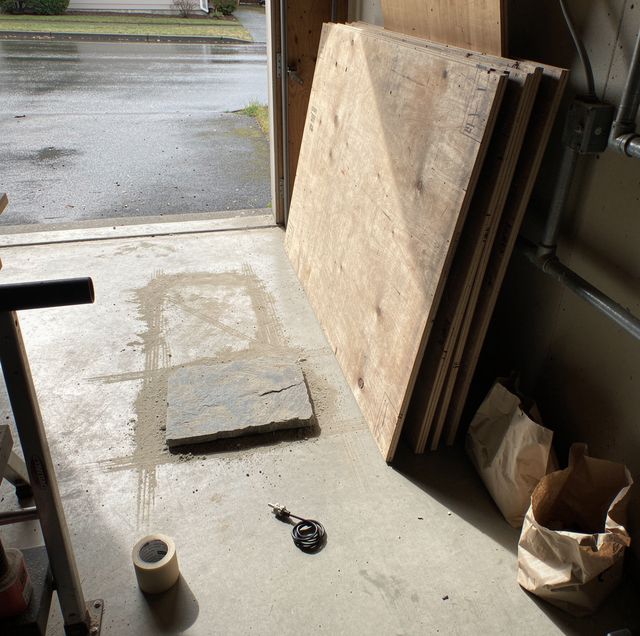
A stone tabletop sits in the shop before a move, on padded sawhorses, while a builder measures it against a stack of plywood. What goes around it will not be a moving box that is larger than usual. It will be a rigid wooden shell built to that slab's dimensions, with a cradle inside that stands the stone on edge, sitting on runners that let a pallet jack slide underneath without anyone touching the top. A carton twice the size, taped shut and stuffed with paper, would contain the same top in the sense that the stone would be somewhere inside it. It would not hold that stone still, and it would not survive being lifted by anything but its own flexing sides. The gap between an enclosure and a load-bearing structure is the reason custom crating exists as its own step, separate from packing.
This piece follows that build in order: measuring, blocking, cushioning, the shell, the closure, and the marking on the outside, then which items justify all six steps, which a well-packed carton already handles, and who makes that call before packing day arrives.
Measuring for the Clearance an Object Actually Needs
A builder measures the object in every dimension, not just height and width but depth, protruding hardware, and the thickest point along its profile. That overall envelope is what the crate has to clear on all sides.
Clearance is not the same instinct as fitting a box snugly around something. A tight shell puts the panel directly against the object, so any flex or bump on the outside transmits straight to the surface it was meant to protect. The clearance a builder leaves is deliberate space, sized for the blocking and cushioning that go in next: too little, and those layers have nowhere to work; too much, and the object shifts before anything can stop it.
Interior Blocking and Bracing That Stops Movement Inside the Box
A crate that fits an object's outline but has nothing holding it in place inside that outline hasn't solved the real problem. Once the shell closes, whatever holds the object has to be structural rather than soft. Blocking fastened to the crate's own frame gives a braking or cornering force somewhere to land: it arrives at a cleat and is carried by the frame instead of by the object. Padding alone cannot do that; it compresses, then rebounds, and the object keeps returning to the wall it was pushed away from.
Blocking is the set of interior cleats and framing pieces fastened inside the crate that contact the object at specific, chosen points and keep it from moving in any direction. Bracing does the same job from the other side, wedging or pinning the object against that blocking so nothing floats. Together, they turn an object sitting inside a box into one fixed to a structure, with the force carried by the frame rather than by the object slamming into a panel.
For pieces with a base or a set of legs, the structure often includes a floating inner pack: an inner frame that holds the object at fixed points, itself cushioned away from the outer shell, so that shock passes through a buffer before it reaches anything rigid.
Choosing the Cushioning Layer for the Object, Not the Box
Cushioning sits between the blocking and the object's surface, and which kind gets used depends on the piece rather than on a default. Foam-in-place is mixed and poured around the object so it cures into a fitted mold, useful for irregular shapes where cut panels leave gaps. Cut foam, shaped in advance to the contours, suits a more predictable profile. Bubble and paper fill remaining gaps rather than carry the main load.
Weight and fragility both drive the choice. A dense, heavy piece needs cushioning that bears sustained compressive load without flattening. A lightweight but easily cracked piece, like glass, needs cushioning chosen to support its edges rather than its face, since pressure on the face of a pane is exactly what breaks it.
Foam-in-place has one requirement that cut foam doesn't: a barrier between its chemistry and the object. The mix goes in wet and expands against whatever it touches, so a release film covers the piece first. That film keeps foam off the finish and lets the cured block lift away at the far end instead of being cut off the object it molded around.
The Shell: How Loads Pass Through a Crate
The outer shell is typically plywood or OSB panels over a frame of cleats and corner framing, with skids or runners built into the base. Those runners keep the crate off the ground and let a pallet jack get under it, so it can be moved and loaded without anyone lifting the object directly.
What makes the shell different from a carton wall is how it carries weight. When freight gets stacked on top, that load needs somewhere to go. In a well-built crate, it travels down through the corner framing to the runners and the floor, not through the flat panel faces. A carton has no equivalent path; set weight on it and the walls buckle inward, whatever sits inside. A crate has to survive being stacked under other freight, which is why the corner framing matters as much as the panel.
A crate built for a single moving day and one built to sit in storage for months aren't solving quite the same problem. A crate that travels once can rely on the trip being short; a storage crate needs an interior that manages humidity over a longer stretch.
A Closure Built to Open Again
The access panel is usually screwed into place rather than nailed. A screwed panel comes off with a driver, cleanly and under control; a nailed one comes off with a pry bar, and prying near a crated object risks the impact the crate was built to prevent.
Prying a crate panel with a bar drives the tool toward whatever is blocked behind it. The crew opens a crate in the room where the piece lands, and a homeowner should not free a blocked object alone.
Someone still has to get the object back out at the other end, and a crate assembled to be reopened, rather than simply sealed shut, makes that step controlled rather than improvised.
A crate that will be opened at the far end benefits from a simple photo of the interior blocking before the lid goes on, so crew on the other end can see how the piece was positioned and secured.
Labeling and Orientation Marking
Once the shell is closed, the outside of the crate carries the only information anyone handling it will have. Orientation arrows and "this side up" markings aren't a formality; the internal blocking was built assuming the object stays in one orientation, and turning the crate on its side loads that structure in a direction it was never designed to carry. Fragile marking works the same way, telling anyone moving the crate not to stack on it without checking what's underneath.
Which Items Actually Justify a Crate
Not everything fragile needs this much structure. A well-packed carton handles most household and office goods without trouble. Crating is for pieces where a carton's flexible walls and lack of internal structure are the actual point of failure.
The useful test is not how breakable an item feels in the hand, but what specifically goes wrong when it rides in a box. A slab and a chandelier are both fragile, and they fail in ways that have nothing to do with each other, so they get two different builds.
| Item Type | The Failure a Carton Allows | What the Crate Does Instead |
|---|---|---|
| Stone or glass slab | Carried flat, the span flexes and the slab cracks under its own weight | Stands it on edge in an A-frame or vertical cradle, foam edge banding along the bearing edge |
| Mirrors and framed art | One corner takes the whole impact and splits the glass and the miter | Dedicated corner blocking so no frame corner bears a point load |
| Large flat panels and televisions | A twist across the diagonal cracks the panel before the outside shows a dent | Bracing that holds the panel plane rigid end to end |
| Chandeliers and lighting | Arms and drops swing into each other inside one padded cavity | Blocking that isolates each arm and glass element |
| Clocks and cased mechanisms | Pendulum, weights, and movement swing free and batter the case from inside | Blocking that immobilizes the movement separately from the case |
| Instruments | Shock reaches the action, and the piece arrives out of adjustment | An inner frame holding playing orientation, cushioned ahead of anything mechanical |
| Electronics with fragile internals | A drive, lens, or board is damaged inside a case that looks intact | Cushioning matched to the item's shock sensitivity, not to the box |
Everyday furniture, boxed goods, and most household items do fine in a well-packed carton. The step up to a crate is for the failure modes above, not a default upgrade for anything breakable.
When the Crating Decision Gets Made
Crating is decided before packing day, not on it. A crate is built to measurements taken directly from the object itself, and plywood has to be cut, framed, and blocked before the truck arrives, so the pieces that need one are identified during the in-home estimate. An item flagged on moving day leaves two options, neither good: the crew improvises with cartons and padding, or the piece waits for a second trip until a crate is available.
The call is made by the estimator with the owner, because three of the inputs are things only the owner knows: whether the piece is replaceable, whether it has been broken and repaired before, since a repaired joint or replaced pane is a weakness the surface does not advertise, and whether anyone will handle it after the crew sets it down, at a storage facility, a restorer, or a second carrier. Each extra handoff is another chance for the piece to be lifted by someone who never saw how it was packed.
That conversation is also where the build gets specified rather than assumed. Runner height for the equipment at both addresses, whether the crate has to clear a doorway or a stair turn, and whether it opens once or several times all change what gets cut, and all are cheaper to answer with a tape measure than with a rebuild.
Frequently Asked Questions
No. A crate is not built airtight, since sealing one completely traps condensation against the object rather than keeping moisture out. Builders leave the design open enough for air to move, because trapped humidity inside a closed shell can do more damage over a long trip than a gap would.
Rarely without rework. The blocking inside is positioned to one object's exact contours, so a crate that fits one piece usually doesn't fit another of similar size without rebuilding that blocking. Some owners keep a crate for the same object long-term rather than treat it as a general-purpose box.
The crate stops using that part as the bearing point. Blocking picks the load up somewhere the piece can carry it: a stretcher, a frame rail, a cast shoulder, and the fragile foot rides with a deliberate gap under it, touching nothing. A figure on a thin stone plinth is the common version: the plinth hangs clear while padded contact at the widest part of the body takes the weight.
It addresses both, but not with the same mechanism. Blocking handles shock, a single jolt or drop. Sustained vibration is a different kind of stress, and some crates add isolating mounts between the object and its blocking to dampen the continuous low-level movement.
Some crates carry a center-of-gravity or lift-point mark, separate from the fragile and orientation stickers, showing crew where a sling, strap, or dolly should contact the crate so that the lifting force lands on the frame rather than on an unsupported panel.
The fasteners give out before the panel does. Wood screws driven into plywood edge grain lose a little grip every time they come out, so a crate expected to open more than once gets threaded inserts or T-nuts set into the frame, and the panel is refastened into metal threads instead of into wood that has already been cut once.
Talk through which pieces in your move need a built crate — get an assessment before packing day, not after something cracks. Butterfield Moving LLC serves Hillsboro, Beaverton, and Portland. Call (503) 867-2414.
