
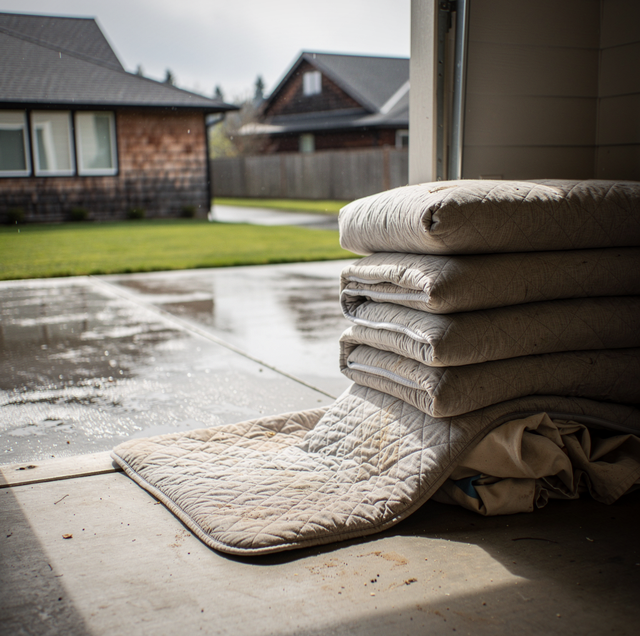
A moving truck does not drop your furniture. It presses it. For every hour your load stands against the weight you packed beside it, your dresser takes a steady squeeze and your sofa a slow rub from every joint that shifts when your driver turns onto your street.
So when your crew reaches your door with quilted pads and no cartons for your dining chairs, you are not watching your movers cut a corner. You are watching them answer your real hazard. Your books want walls. Your headboard wants a face on it, and it wants that face to stay where you put it, from your hallway to your new one. Your carton keeps your books square; your pad keeps your finish whole.
The Damage a Truck Does to a Load
Damage on a moving truck is almost always one of two kinds. The first is compression. A load is built tight on purpose, so every piece carries part of the weight of whatever leans against it for the whole drive. The second is abrasion. Nothing on a truck is perfectly still, and a surface pressed against another with a little movement between them will polish, then scuff, then mark.
What almost never happens is a drop. A crew is not throwing furniture; a load is carried, set down and built. A carton exists to absorb a blow and to give a stack something square to sit on, which makes it right for the kitchen and wrong for a headboard.
Once you see those two failure modes apart, the material question answers itself. Compression wants thickness and give so that a load can settle without a hard edge printing itself into the finish. Abrasion wants a soft face that moves with the piece rather than against it. A quilted pad does both jobs. Corrugated board does neither: it crushes, and its cut edges score a veneer.
What Rubs a Finish Raw on a Loaded Truck?
The rubbing is not one big movement. It is thousands of tiny ones, and what matters most is whatever sits between the two surfaces while they happen. Grit is the culprit. Dust off a garage floor, sand tracked in on a boot, a crumb of drywall from the hallway: pressed between a cover and a table leg for an hour, any of it works like a very fine abrasive.
The order of the layers is the whole technique. A blanket against the piece gives grit somewhere to go, because it sinks into the quilt's nap rather than being held tightly against the surface. The film goes over the blanket, and its only job is to hold it still. Reverse them, and you press grit into the finish.
Pads First, Film Over the Pads
The professional order is padded blankets against the piece, with film over the pads to lock them in place. It costs thirty extra seconds per piece, and it's the difference between protection and packaging. Packaging, in that sentence, means the thing that looks wrapped from outside. Protection means the thing that comes off the truck the way it went on.
Leather earns a clause of its own: breathable pads only against the hide, because film-wrapped leather in a warm truck sweats, and sweated leather remembers. A truck box heats all afternoon, and plastic against a hide traps what that hide gives off. The marks stay.
None of this makes a carton useless; it makes it specific. Cartons carry what benefits from four walls and a lid: books, plates, lamps with the shades off, anything that needs a shape imposed on it. Case goods have walls already. What they need is a face, and quilting gives them one.
Blanket or Carton, Side by Side
A side-by-side view makes the division obvious once you name the damage before you name the container. Read the middle column first, because the cover on the right follows from it, not from how delicate a piece feels in your hands.
| The piece | What the truck does to it | The right cover |
|---|---|---|
| Dresser, table, headboard | Steady pressure, hard edge contact | Pad against the wood, film over the pad |
| Books, plates, small goods | Shifting and crushing in bulk | Carton, packed tight to the lid |
| Upholstered sofa or chair | Dust ground into the weave | Pad against the fabric, film outside |
| Leather seating | Trapped heat and moisture | Breathable pad only against the hide |
| Mirrors, framed art, glass tops | Flex and point loading | Padded, upright, anchored between tiers |
Two rows there repeat the same instruction from opposite directions. Nothing that seals goes against the thing you are trying to protect, and the sealing layer earns its place only by holding the soft layer still.
Tiers, Straps, and the Pieces a Pad Cannot Cover
Wrapping is only half of what keeps a piece whole. Pads first, film over pads, never film on bare finish. Pieces load in engineered tiers with straps, heavy bases down, so nothing shifts between here and there. Stacking furniture into tiers in a truck without strapping each tier is how a wall of goods comes down on whoever opens the door at the far end, and strapping every tier as it is built belongs to the moving crew, never to you.
Some pieces carry a hazard the blanket has nothing to do with. Sleeper sofas hide about seventy pounds of steel mechanism, and a recliner hides a footrest sprung to swing out on its own. On flat ground, that combination is a nuisance. On a staircase, with two people at different heights and one walking backward, it is s takes the weight.
Never carry an unsecured recliner or sleeper sofa down a staircase yourself; have the moving crew strap the mechanism first, because a footrest deploying mid-flight injures whoever is carrying the low end.
A few things sit outside what any blanket can do. Mirrors, framed art and glass tops travel upright, padded and anchored between tiers, never flat, because glass fails by flex and no thickness of quilting will stiffen a sheet. A piece that truly needs a crate belongs with a fine-art shipper. Everything else gets the blanket, and it helps to know what the blanket is actually doing: it is a thick soft face that takes the pressure your load builds, absorbs the grit your floors gave up, and stays still against your finish the whole way.
Frequently Asked Questions
Rarely, and never for case goods. A carton around your dresser adds a crushable layer between the piece and the strap, which makes your load less stable, not more. You will see boxing for knock-down parts, hardware bags and shelves once furniture is apart.
You can, though it often comes off again. Crews pad to fit the piece and the position it will take, and a wrap applied the night before rarely matches either. If you want to help, clear the path, empty your drawers, and leave the covering to the crew.
No, and a short move is where the temptation is strongest. Film on bare finish is the combination the method exists to prevent: it traps moisture against lacquer and holds any grit on your surface hard against it. Twenty minutes is long enough to leave you a mark you keep.
They come off as your pieces land, get folded at the tailgate of the truck, and go back out on the very next job. The pads are rented and reused, never sold to you with your move, and a pad that is cut or soaked leaves the rotation for good.
Usually yes, and the two steps belong together. A glass top and its base take different covers and different positions, so separating them makes both positions possible. Why does a trained crew lock or strap the mechanism before anyone? Your crew removes your top, pads it, stands it upright between tiers, then pads the base and loads it on its own feet, which keeps your glass out from under the weight.
Because the damage wrapping prevents is not measured in miles. Compression starts the moment your load is built tight and continues while the truck stands still. Abrasion needs only the small movements of loading, turning, and braking, and a short route has as many corners per mile as a long one. The first ten minutes of a drive put the same pressure on your dresser as the last, which is why the pad goes on whether the drive is three blocks or three hundred miles.
Book a furniture move where the wrapping is part of the plan — a crew that pads, films, and tiers your pieces in the right order, with disassembly and reassembly at both ends. Butterfield Moving LLC serves Hillsboro, Beaverton, and Portland. Call (503) 867-2414.