
How Many Boxes Will You Actually Need? A Room-by-Room Estimate
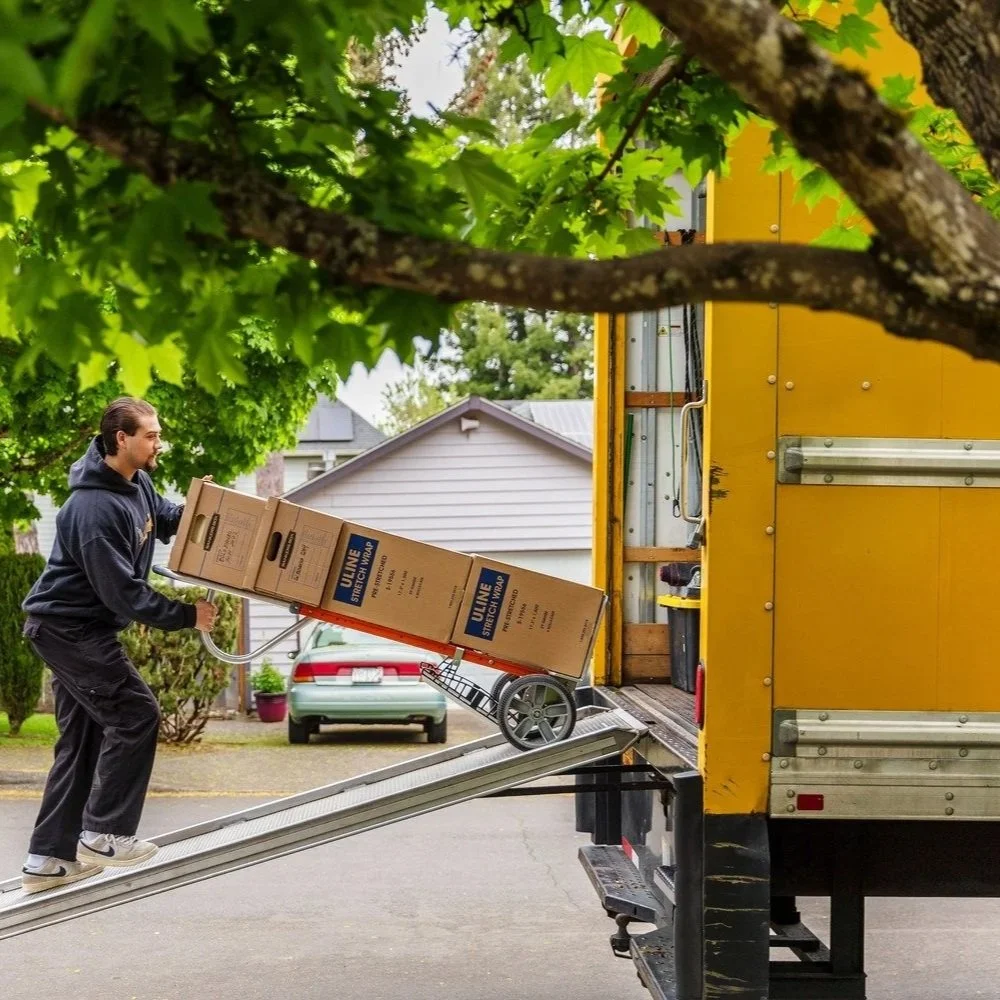
A mover carefully loads stacked moving boxes into a yellow moving truck using a dolly, highlighting the organized process of residential relocation, safe packing, and efficient transportation during a home move in a quiet neighborhood setting.
You are staring at a move and thinking: “How many boxes do I actually need?” Most people guess wrong. Some buy 20 boxes and run short halfway through. Others buy 100 and end up storing 30 empty boxes in their new garage. This guide gives you a room-by-room breakdown so you can order confidently and pack without panic.
How Many Boxes Do You Actually Need? (Quick Answer)
The quick lookup: A studio or one-bedroom apartment typically needs 30 to 50 boxes. A two-bedroom apartment or small house needs 50 to 80 boxes. A three-bedroom house needs 100 to 150 boxes. A four-bedroom house needs 150 to 200 boxes. A five-bedroom home or larger needs 200 to 300+ boxes.
These numbers assume you are moving most of your belongings. If you are downsizing aggressively—donating or selling furniture and clothes before the move—subtract 20-40%. If you are moving with minimal furniture (renting or minimalist lifestyle), subtract 10-20%.
The math is straightforward: Smaller homes have fewer rooms and fewer possessions. Larger homes have more stuff, even if the household size is similar. The variable that matters most is not the number of people but how much stuff each person has accumulated.
Room-by-Room Breakdown
Here is what each room type generates in boxes:
Kitchen: 15 to 25 boxes (dishes, glassware, canned goods, cookware, small appliances)
Bedroom: 12 to 20 boxes per bedroom (clothes, bedding, books, nightstands, lamps)
Living room: 10 to 15 boxes (books, DVDs, decorative items, electronics, throw pillows)
Bathroom: 4 to 8 boxes (toiletries, towels, cleaning supplies, hair care)
Home office or den: 8 to 15 boxes (documents, office supplies, equipment, shelving)
Garage or storage: highly variable (tools, seasonal items, exercise equipment, sports gear)
The kitchen surprises people. A typical kitchen generates 15 to 25 boxes because every single item is either fragile (glassware, dishes, stemware) or dense (canned goods, cookware, spice bottles). Movers often pack kitchens separately because the weight distribution is uneven: kitchen boxes are heavier per box than bedroom boxes.
If you have a home office with filing cabinets, papers, and equipment, plan for 8 to 15 boxes for that room alone. Office supplies are both dense and bulky.
Garages are wild cards. Some garages hold nothing but a car and a rake. Others hold a lifetime of accumulated tools, camping gear, holiday decorations, and sports equipment. If your garage is stuffed, plan for 30 to 50 boxes. If it is sparse, plan for 5-10.
The Kitchen Exception (Why It Takes More Boxes Than It Looks)
Kitchens are the most densely occupied rooms in any home. A typical kitchen has 1,000+ items: individual plates, glasses, bowls, mugs, utensils, pots, pans, spice jars, canned goods, appliances, utensil drawers, and cabinet contents. Pack this room first because it is the most time-consuming and box-heavy.
Most people underestimate kitchen boxes. They see a kitchen and think, “Maybe five or six boxes?” Then they start packing: the first box holds eight plates, four bowls, six glasses, and a teapot—already near the weight limit at 35 pounds. A second box holds spices and oils (heavier than expected). A third holds mugs and additional glasses. The fourth holds cooking utensils. The fifth holds canned goods. The sixth holds small appliances. And you have not packed the pots, pans, or larger equipment yet. Ten boxes for a kitchen is typical, and fifteen to twenty-five is realistic for a full kitchen.
Weight is the constraint. A standard moving box has a weight limit of around 40 to 50 pounds before it risks breaking. Kitchen items are dense, so you hit weight limits faster with fewer items. Pack kitchen boxes conservatively.
Decluttering Changes Your Box Count
Here is the reality that reframes box counts: people who downsize before moving cut their box count by 20-40%. A household moving from a three-bedroom house to a two-bedroom apartment that donates one bedroom’s worth of stuff reduces from 120 boxes to 80–100 boxes.
Declutter before you pack. Go room by room. Ask yourself: Do I actually use this? Will I unpack this in the new place? If the answer is no, donate or sell it. Thrift stores (Goodwill, Salvation Army, local nonprofits) take furniture, clothes, books, and household items. Facebook Marketplace and Craigslist connect people who want larger items with those who have them. Online selling (eBay, Depop) works for valuable items.
The tax benefit is real. Donations to qualified nonprofits are tax-deductible. Keep a list of what you donate and photograph the collection so you have proof for your tax return.
DIY Packing vs. Professional Packing (Box Count Difference)
Professional packers use space more efficiently than DIY packers. A professional packing a bedroom will nest boxes tightly, use void fill efficiently, and maximize cubic feet per box. A DIY packer leaves air gaps, packs boxes loosely, and sometimes underutilizes box volume. Professional packing typically reduces the total box count by 10 to 20 percent compared to DIY packing.
If you are packing yourself, that is fine. Expect to need more boxes than the estimates above suggest. If you hire Butterfield to pack (at the same hourly rate as moving, $146.95/hour), the crew will pack more efficiently, and you may need fewer boxes overall.
Most people pack their own clothes, books, and decorative items (which are straightforward) and hire help for the kitchen, office, and garage (which are dense and time-consuming). This hybrid approach keeps costs down and saves you from the tedious parts.
How to Get Boxes Without Overstocking
New boxes from U-Haul, packing supply stores, or big-box retailers cost money and often come in bulk. A pack of ten medium boxes costs $15–$20. Before you buy in bulk, test the estimate: pack one room fully and count the boxes. If your bedroom took six boxes as predicted and you estimated 80 total, go ahead and buy 80. If your bedroom took ten boxes, adjust upward.
Used boxes (slightly dented, previously used) are cheaper. Grocery stores, liquor stores, and bookstores often have free boxes in back if you ask. Farmers' markets sometimes have produce boxes. Facebook Marketplace has free-box listings from people who have just moved. These boxes are perfectly functional even if they are not pristine.
The risk of overstocking is real. If you buy 100 boxes and use 70, you now have 30 empty boxes taking up space in your new home. Flatten them and recycle them, or offer them for free on Facebook Marketplace. Do not store empty boxes “in case you need them later”—they attract clutter.
When to Start Boxing and Packing Timelines
Timing is practical math. A two-bedroom apartment has roughly 60 boxes. If you pack four boxes per day, you need two weeks. If you pack six boxes per day, you need ten days. Most people can pack a bedroom in an afternoon (five boxes) and a kitchen in a morning (ten boxes), so the timeline expands when you account for other rooms, breaks, and the fact that packing is tedious work you do after your regular job.
If you are moving in two weeks and have not started packing, plan to pack 4 to 5 boxes per day. If you start four weeks out, you can pack 2 to 3 boxes per day without exhaustion. The earlier you start, the gentler the pace.
Pro tip: pack room by room and label each box with the room and contents (“Kitchen—Glasses and Mugs,” “Bedroom 1—Socks and Underwear”). This helps you unpack efficiently and makes it obvious if a box never left the truck.
FAQ
Yes. Smaller boxes work well for heavy items (books, kitchen equipment) because you can safely pack more weight in a smaller box. Larger boxes work well for lightweight items (such as pillows, linens, and clothes). Most moves use a mix of sizes.
Not at Butterfield. The rate is per hour, not per box. If you have 150 boxes and they take three hours to load, you pay for three hours. If you have 75 boxes and it takes three hours, you will still be charged for three hours. Box count does not increase the charge; the time it takes to load does.
Books and office supplies. A box of hardcover books is surprisingly heavy—it can hit 40 to 50 pounds easily. Office supplies (files, binders, equipment) are similarly dense. Pack these boxes conservatively and do not overfill them.
Label while you pack. Grab a permanent marker and write the room and contents on the top and at least one side of each box. If you wait until all boxes are packed, you will waste time trying to remember what is in each one. Labeling as you go is faster and more accurate.
Yes. Boxes hold up to multiple moves if they are not damaged. Inspect them for soft spots, water damage, or crushed corners before reusing. Replace boxes that look weak.
Make a decision first. If you are keeping 70 percent of your furniture and donating the rest, estimate based on that. If you are undecided, pack what you know you are keeping and store the “maybe” items for later. Many people discover they do not miss things they stored and end up donating them a year later anyway.
Call Butterfield Moving at (503) 506-4149 for a free estimate that includes box-count and packing timeline recommendations. Open 7 days a week, 7 am to 10 pm.