
How to Move Art and Antiques Without Damage: 9 Steps
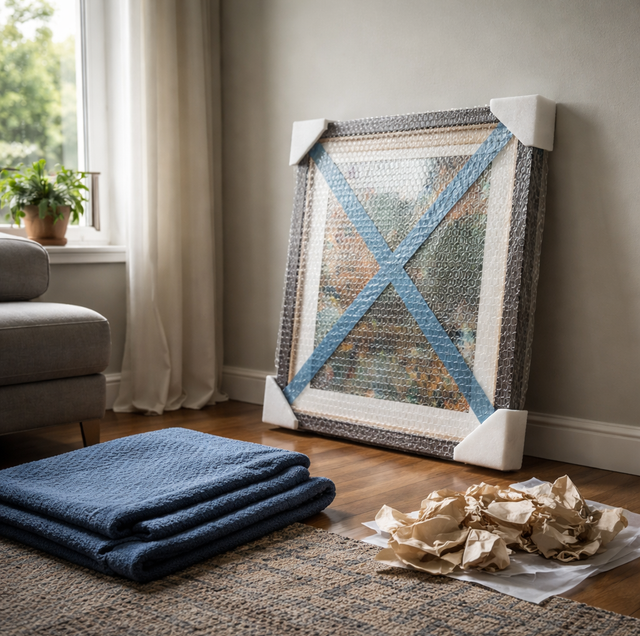
Quick Answer: Photograph each piece and note its condition, wrap finishes in acid-free tissue or glassine before any bubble wrap, keep bubble wrap facing out so it never touches the surface, pack paintings vertically in mirror boxes or custom crates, tape an X across framed glass, protect loose joints and veneer with padding, and hire specialty crating for anything irreplaceable or high-value.
A framed painting, an inherited chest of drawers, a signed print behind glass. These pieces carry value that a replacement check can never restore, and that changes how they should be handled during a move. The wrapping that protects a sturdy dresser can leave a mark on an oil painting. The lift that works for a bookshelf can pop a loosened joint on a century-old table. Moving art and antiques safely starts with understanding what makes them fragile, then matching the right materials and methods to each risk before anything gets carried out the door.
Why Art and Antiques Need Special Handling
The problem is rarely weight. A small watercolor weighs almost nothing yet ranks among the hardest items to move without harm. Four traits make these pieces vulnerable in ways ordinary furniture is not.
Fragile finishes. Antique shellac, French polish, gilding, and old varnish were never made to survive contact with plastic or adhesive. Bubble wrap pressed against a finish can print its pattern into a soft surface, especially in warm weather. Tape adhesive can lift gilding or pull up a top coat when it comes off.
Glass and its cargo. Framed art and mirrors combine two hazards: the glass itself can shatter, and the shards can slash the artwork or photograph behind it. A break is rarely just a break.
Joints and veneer loosened by age. Wood movement over decades leaves old furniture with glue joints that have gone brittle and veneer that has started to lift at the edges. Handles, finials, and drawer runners often carry hairline stress that a single awkward lift will finish off.
Irreplaceable value. A production sofa can be reordered. An original canvas or a family heirloom cannot. That single fact justifies extra time, better materials, and, for the highest-value items, professional crating.
Assess and Document Every Piece First
Before wrapping anything, walk each item and record its state. Photograph the front, back, corners, and any existing chips, cracks, or losses in good light. Close-ups of a frame corner or a lifting veneer edge do two jobs: they give you a baseline if a claim ever comes up, and they force you to notice weak points before you handle the piece.
Write a short line for each item noting what already looks vulnerable, a wobbly leg, a cracked frame joint, a bloom in the varnish. That note tells whoever wraps and lifts the piece where to be gentle.
For anything you suspect is truly valuable, this is the moment to get an appraisal and confirm how your moving coverage treats fine art and antiques. Standard released-value protection is weight-based and pays very little on a light, precious object, so ask specifically about full-value or separate fine-art coverage before the truck is loaded.
The Right Materials, and What to Keep Off the Surface
Good outcomes come from the layer that touches the piece, not the layer you see. Assemble these before packing day.
Acid-free tissue and glassine: These go against finishes, painted surfaces, and the face of works on paper. Glassine is a smooth, moisture-resistant sheet that will not stick to varnish or pull pigment. Acid-free tissue cushions gilding and carving without the chemical risk of ordinary newsprint, which can transfer ink and, over time, acid.
Bubble wrap, facing out: Bubble wrap belongs on the outside of the soft layer, bubbles facing away from the object. Put tissue or glassine down first, then bubble wrap over that. The bubbles should never press directly on a finish or a canvas.
Always lay acid-free tissue or glassine directly against a finish or canvas first, then put bubble wrap over it with the bubbles facing away from the piece. Pressed straight onto a soft or aged finish, bubble wrap can print its pattern into the surface, and tape can lift gilding or a top coat when it comes off.
Painter's tape, never on the finish. Use painter's tape only to secure wrapping to itself, never to the wood, paint, gilding, or glass. Even low-tack tape can mar an aged surface. Tape the paper to the paper.
Corner protectors, moving blankets, and mirror boxes. Foam or cardboard corner protectors shield the most exposed points of a frame. Moving blankets pad case furniture over its wrapping. Telescoping mirror boxes hold flat framed work, and a custom crate is the answer for a large canvas, a marble top, or anything you cannot afford to lose.
How to Pack Framed Art and Mirrors
Framed pieces behind glass follow their own sequence.
Tape an X across the glass. Run strips of painter's tape corner to corner in an X, plus a border inside the frame edge, laying tape only on the glass, never on the frame finish. The tape will not stop a break, but it holds cracked glass together so shards stay put instead of migrating into the art.
Wrap in order. Lay a glassine or tissue sheet over the face, then a layer of bubble wrap facing out, then fit corner protectors. Slide the piece into a right-sized mirror box or crate so it cannot shift.
Stand it up. Load and transport framed glass and mirrors on edge, vertically, like records in a crate, never flat and never stacked with weight on top. Flat glass under pressure is far likelier to crack.
How to Pack Paintings and Works on Paper
Unglazed paintings, an oil or acrylic with no glass in front, need the surface kept clear.
Never let anything touch the paint layer. Build a shallow spacer, such as a frame of foam board slightly thicker than the canvas is deep, so the covering rides above the surface with an air gap. Cover with glassine, then bubble wrap facing out, then box or crate.
Like framed glass, paintings ride vertically, on edge, never flat. A canvas laid flat can flex and dimple under its own covering or a stray hand pressed on top. Keep the piece upright from wrap to truck to new wall.
How to Protect Delicate Joints and Loose Veneer on Antiques
Old furniture asks for a different kind of care than a heavy modern dresser.
Immobilize the moving parts: Remove or secure drawers, doors, leaves, and any finials or hardware that can swing or fall. Pad each removed part separately and label it so reassembly is obvious.
Support the structure, not the trim: Lift from the solid frame, never by a handle, a carved edge, a table leaf, or a chair arm, all of which are joints waiting to give. A loose veneer edge should be covered with tissue and padded so nothing catches and peels it further.
Wrap, then blanket: Tissue or glassine against the finish, then a moving blanket over that, secured with wrap or straps that press on the blanket rather than the wood.
Anything heavy or awkward is a two-person lift. Two people protect both the piece and their own backs, and a team keeps control through a doorway or down a stair where one person would be forced to set the load down badly.
Climate and Humidity Awareness
Wood and canvas react to moisture and temperature, and they do it in both directions. Damp air swells wood and slackens a canvas; dry heat shrinks and embrittles them. Rapid swings are the real enemy, since the surface and the core move at different rates and the finish can craze or a joint can open.
The practical rule holds year-round. Do not leave wrapped art in a hot truck baking in summer sun, and do not stage it in a cold, damp space in the wet months. Keep transit times short, avoid parking a loaded truck in direct heat, and let a piece acclimate to the new room before you unwrap it rather than exposing a cold, wrapped object straight to warm indoor air.
When to Bring in Specialty Movers and Crating
Some pieces are past the point where careful packing at home is enough. Call for professional, white-glove handling when an item is large and unwieldy, structurally fragile, worth more than you could comfortably replace, or simply irreplaceable. White-glove service means trained handlers, custom-built crates measured to the object, padded transport, and placement in the destination room, all handled so you never carry the risk yourself.
A custom crate built to the piece is the strongest protection there is for a major canvas, a stone or marble top, a large mirror, or a signed work. If you are weighing whether a piece qualifies, the value and the impossibility of replacement, not the size, should decide it.
Frequently Asked Questions
Let framed art, canvases, and solid-wood antiques sit wrapped in the destination room for roughly 24 hours before opening them. That pause lets the object's temperature meet the room's so condensation does not form on cold glass or inside the wrapping, a common cause of moisture spotting on paper and mold on the back of a frame.
No. A grandfather clock needs its pendulum, weights, and chime rods removed and packed separately first, and tall case clocks should travel upright and strapped so the movement is not stressed. Left assembled, the swinging weights can crack the case or bend the chime rods during transit.
Handle a flaking gilt frame with clean cotton gloves and do not wipe it, since skin oils and rubbing lift more gilding. Wrap it loosely in glassine without pressing on the ornament, and if flakes are already detaching, collect them in a labeled bag so a conservator can reattach them later rather than losing them in the packing.
Stone tops are heavy but brittle and crack along the grain, so they must travel on edge, never flat, ideally in a custom crate with foam edge support. Wrap the surface in glassine first, because some plastics and tapes can leave a residue or faint etching on polished marble that is difficult to remove.
For a high-value canvas or work on paper in a long-distance crate, a small humidity indicator card or a silica gel pack inside the crate flags whether moisture built up in transit. Silica keeps relative humidity from spiking, and the card gives a conservator a quick read on whether the piece saw conditions worth inspecting for.
Wrap a sculpture with the most fragile projections, an outstretched arm, a thin handle, splinted with rolled tissue or foam so they cannot snap, then nest the piece in a box with the base weighted downward and packing filling every void. Ceramics and plaster fail at these thin points first, so support them individually rather than trusting one thick outer wrap.
Ask about white-glove packing before your next move — trained handlers and custom crates protect what cannot be replaced. Butterfield Moving LLC serves Hillsboro, Beaverton, and Portland. Call (503) 867-2414.