
How to Pack Fragile Items So Nothing Breaks in Transit
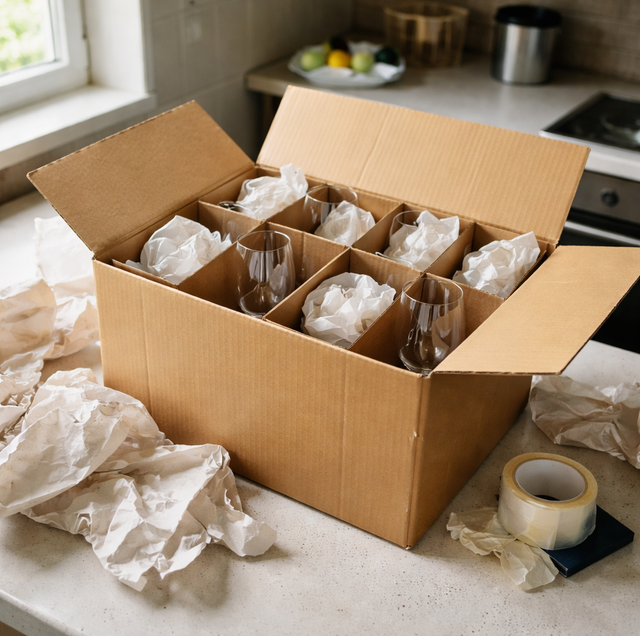
Quick Answer: Pack fragile items by wrapping each piece individually in paper or bubble wrap, filling every empty space in the box so nothing can shift, and cushioning the top and bottom with crushed paper. Keep fragile boxes light, label them FRAGILE and THIS SIDE UP on multiple sides, and load them on top in the truck.
Breakage rarely happens because something was dropped. It happens because a box was packed loose, stacked wrong, or filled with items that could slide into each other every time the truck turned a corner. A wine glass that survives a two-foot fall onto carpet will shatter if it rattles against a neighbor for twenty miles. Once you understand why fragile things fail, the packing method almost designs itself.
The Three Ways Fragile Items Actually Break
Before reaching for tape, it helps to know the enemy. Nearly every broken plate or cracked screen traces back to one of three failure modes, and each one has a matching defense.
Impact is the obvious one: a box dropped on a corner, a lamp knocked off a stack. The force arrives fast and lands on one spot. The answer is cushioning, a layer of give between the object and the outside world that spreads the blow out over time and area instead of letting it land on one edge.
Pressure is quieter. Stack a heavy carton on a box of glasses and the weight bears straight down through the walls onto whatever is inside. Plates crack, boxes bow, corners collapse. The defense is packing fragile boxes lighter than they can hold, choosing sturdy cartons that carry load through their walls, and never letting a fragile box sit at the bottom of a stack.
Shifting is the sneaky one, and it causes more losses than a dramatic drop ever does. Any void inside a box, any gap between wrapped items, becomes room for movement. Over the length of a move, thousands of tiny slides and taps add up until a rim chips or a stem snaps. The answer is immobilization: wrap each piece and fill every gap so that when you close the box and give it a gentle shake, you feel and hear nothing move.
Cushion, immobilize, label. Those three verbs are the whole method, and the sections below turn each into specific moves.
Gather the Right Supplies First
Good packing starts at the supply table, not the shelf. Trying to protect stemware with grocery-store newspaper and a flimsy carton is a losing effort before it begins.
- Dish-pack (also called dish-barrel) cartons and small boxes. Dish-packs have double-thick walls built for weight-bearing pressure. Use small boxes for other heavy fragiles so the total weight stays liftable.
- Packing paper, plenty of it. Clean newsprint wraps pieces and, when crushed, fills voids. Buy far more than you think you need; a single kitchen can eat a full bundle.
- Bubble wrap for anything with a screen, a finish, or real value. The bubbles are the cushioning layer that absorbs impact.
- Cell dividers (partition kits), the cardboard grids that give each glass its own compartment so pieces never touch.
- Foam corners and foam pouches for framed art, tablets, and small electronics.
- Packing tape and a wide marker. Tape the bottom seam of every box in an H pattern down the center and across both edges so the flaps cannot spring open under weight.
A quick way to test a carton: press on its walls. If they flex easily, it will not resist crushing pressure. Set it aside for linens and use a sturdier box for anything breakable.
Wrap Each Piece and Kill Every Void
This is where cushion and immobilize come together, one item at a time.
Lay several sheets of paper flat, set the piece near one corner, and roll it up, tucking the paper ends in as you go so the item is fully enclosed with no bare spots. A single mug wants two or three sheets; a serving platter wants more. For anything you would grieve over, add a layer of bubble wrap on top of the paper.
Then build the box from the bottom up. Crush a two- to three-inch pad of paper across the floor of the carton first, so nothing rests directly on the base where an impact would transfer straight through. Set the heaviest wrapped items in first, lighter ones above. As you fill, tuck crushed paper into every gap along the walls and between pieces. The finished box should feel solid, not shifty. Close it, lift it, and rock it gently. If you hear a clink or feel a slide, open it and add more fill. Silence is the goal.
After filling a box, close it, lift it, and rock it gently. If you hear a clink or feel anything slide, open it and add more crushed paper into the gaps until the box is silent, because any void inside is room for pieces to shift and chip over the length of a move.
Finish with another pad of crushed paper across the top before you close the flaps, so there is cushioning between the contents and the next box that gets stacked on top.
Plates, Bowls, and Platters: Wrap each plate individually, then stack the wrapped plates and stand them on edge in the box, vertically, like records in a crate. On their edges, plates flex and absorb road vibration far better than they do lying flat, where a stack acts like a stiff column that cracks under pressure. Bowls can nest in small groups only if each is wrapped first, and even then they ride better standing on edge. Keep a thick paper pad on every side.
Glasses and Stemware: Cell dividers earn their keep here. Wrap each glass in paper, stuffing a little into the bowl for internal support, then slot one glass per cell. Stemware is the most fragile thing in most kitchens because the stem is a natural break point; wrap the stem with extra paper and consider a purpose-made stemware carton with tall cells. Never let two glasses share a compartment.
Double-Boxing the Truly Irreplaceable: For a crystal vase, a ceramic heirloom, or anything you cannot replace, use two boxes. Wrap and pack the piece snugly in a small box, then set that box inside a larger one with two to three inches of crushed paper or bubble wrap on all six sides. The outer box takes the hits; the inner box floats in the middle, insulated from both impact and pressure.
Mirrors, Art, Lamps, and Electronics
Some items need their own approach rather than a box of fill.
Mirrors and framed art go in telescoping mirror boxes sized to the piece. Before boxing, run painter's tape in a large X across the glass face. The tape will not stop a break, but if the glass does crack, the X holds the shards together instead of letting loose broken glass slide around, which is a real laceration hazard when the box is opened. Pad the corners with foam protectors and stand the box on edge, never flat.
Lamps come apart. Remove the shade, the harp, and the bulb, and pack each separately. Wrap the base like any fragile item. Shades are crushable and should travel nearly empty in their own box, with only soft paper around the outside edge, never packed tight against a hard object.
Electronics ride best in their original boxes with the molded foam inserts, which were engineered for exactly this. If those are long gone, wrap the unit in an anti-static pouch or bubble wrap, cushion it on all sides in a snug box, and keep the cords bundled separately so a connector cannot press into a screen. Loose fine china and delicate serving pieces follow the same wrap-and-fill rules as everyday dishes, just with extra bubble wrap and more patience.
A packed box is a lot like a well-set bone: it holds because nothing inside can move against anything else. If a piece can wander, it will eventually find the one position that breaks it.
Label, Load, and Lift the Smart Way
The last stage protects everything you just packed.
Mark every fragile box on at least two side faces (not the top, which disappears once boxes are stacked) with FRAGILE and THIS SIDE UP, plus a note of the contents and the room it belongs in. Arrows help anyone carrying the box keep it oriented correctly.
Keep fragile boxes deliberately light. A box of glasses should be liftable with ease; the empty space that tempts you to add more is doing the cushioning work, so leave it. In the truck, fragile boxes load last and ride on top of heavier, sturdier cartons, never underneath them, and snugged against a wall or strapped so they cannot tip during transit.
Some fragile pieces are also heavy: a large mirror, a marble tabletop, a big television. Those are a team lift, two people minimum, with a clear path and a plan for who sets down first. Straining to carry an awkward heavy piece alone is how both the item and your back get hurt.
Weather is a year-round factor, not a seasonal one. Damp air can warp paper padding and slick a driveway in the rainy months, while dry heat can make some finishes brittle and tape adhesive gummy in summer; either way, keep fragile boxes covered, off wet ground, and out of a baking truck when you can.
When a Crate or Professional Packing Pays Off: Not everything belongs in a cardboard box. A large framed piece, a stone or glass tabletop, a chandelier, or a high-value collectible is often safer in a custom wooden crate that resists both crushing and puncture. If an item is truly irreplaceable, or if you simply do not have the time to wrap a whole kitchen the right way, professional packing is worth considering. Experienced packers carry the materials, work quickly, and take on responsibility for the pieces they handle, which is peace of mind that matters most for the things you would never want to replace.
Frequently Asked Questions
Fragile packing is slow, roughly two to four times slower than filling a box with books, so start with fragiles first rather than saving them for the frantic final night. A good rule is to pack one to two rooms of breakables per evening in the week before the move. Rushing is the single biggest cause of skipped padding and half-filled boxes.
They do different jobs, so use both. Paper is best for the first wrap and for filling voids because it molds around shapes and cushions vibration cheaply. Bubble wrap adds a springier impact layer and is better as a second wrap for screens, finished surfaces, and high-value pieces. When you use bubble wrap directly against a delicate surface, face the flat side inward so the bubbles do not press a texture into a soft finish.
Soft goods work for medium-durability items and can save on supplies, but they have limits. Towels are too bulky to wrap individual glasses well and leave large voids where items shift. They also offer no rigid protection for edges and corners. Use them for padding sturdier pieces or lining a box, and reserve paper and cell dividers for stemware, plates, and anything truly breakable.
Fill it, do not leave it open. Any headspace lets the top layer bounce when another box is stacked above. Add crushed paper until the flaps close with slight resistance and the contents cannot press upward. If you find yourself with a lot of leftover room, repack into a smaller box instead; oversized cartons invite both shifting and crushing.
Sheath each blade before wrapping. Slide knives into a knife guard, a folded piece of stiff cardboard taped closed, or a dedicated blade sleeve so the edge cannot cut through paper or a hand reaching into the box. Wrap the whole bundle, label the box as containing sharps, and point the handles toward the same end so whoever opens it knows where to reach.
Note it immediately and photograph the damaged piece and the box it came from before moving anything else. If broken glass is involved, wear gloves and gather the shards into a rigid container rather than a bag, since edges slice through plastic. Keeping the packaging intact matters if you have moving valuation coverage or insurance, because a claim usually asks how the item was packed and how the damage occurred.
Get a packing plan built around your most fragile pieces — so your glassware and heirlooms arrive exactly as they left. Butterfield Moving serves Hillsboro, Beaverton, and the Portland area. Call (503) 867-2414.