
How to Prepare Appliances for a Move Without Wrecking Them
Quick Answer: Start appliance prep two to three days ahead of moving day. Disconnect power and water, drain and dry the interior to stop mold, lock or brace any moving parts, and coil the cords. Leave gas connections to a licensed professional or the utility. A refrigerator should ride upright and sit unplugged for several hours at the new home before you power it on.
The heaviest, most expensive things you own often get the least prep. People wrap dishes in three layers of paper, then wheel a refrigerator out the door with water still sitting in the drip pan and a power cord dragging on the concrete. Large appliances are not last-minute items. They hold water, spin heavy drums, run on compressors, and sometimes connect to a gas line, and each of those systems needs to be shut down, emptied, and locked in place before the machine leaves the house.
Why Appliances Need Days, Not Minutes
A moving box does not care how it is handled the day before. An appliance does. Four systems inside these machines behave badly if you rush them.
Water is the first. Refrigerators, washers, and dishwashers all hold standing water in lines, pumps, drip trays, and drums. Any water left inside will slosh during transport, soak into insulation, and sit in a dark closed cabinet for hours or days. That is exactly how mold and a sour smell take hold. Draining and drying is not tidiness; it is the difference between plugging in a clean machine and opening a moldy one.
The second is moving mass. A washer drum hangs on springs and shock absorbers so it can spin at speed without tearing itself apart. Loose on the road, that same drum swings and hammers the outer tub, and can crack the suspension or the plastic housing. That is why washers ship with transit bolts, covered below.
Third is the compressor. A refrigerator's compressor uses oil and refrigerant that need to settle. Lay the unit on its side or run it right after a move, and oil can migrate into lines where it does not belong.
Fourth is gas. A gas range or gas dryer connects to a fuel line, and that connection is the one part of this whole process a homeowner should not touch. More on that in the safety steps.
There is also the matter of weight. A full-size refrigerator can top 300 pounds. These are team-lift items with real tip and crush risk, and the prep below also exists so the crew can move them without a cord catching a foot or a door swinging open on the stairs.
Think of appliance prep the way a diver checks gear before going under: every hose, latch, and valve gets confirmed on dry land, because there is no fixing it once you are committed and the truck is loaded.
Refrigerator and Freezer
The fridge takes the most lead time, so start here.
Empty and defrost 24 hours out: Eat down or give away perishables in the days before. The night before loading, pull everything out, unplug the unit, and prop the doors open so the freezer can defrost fully. A full defrost usually needs a solid 24 hours. Ice left in the coils and evaporator melts in transit and drips wherever the truck takes it.
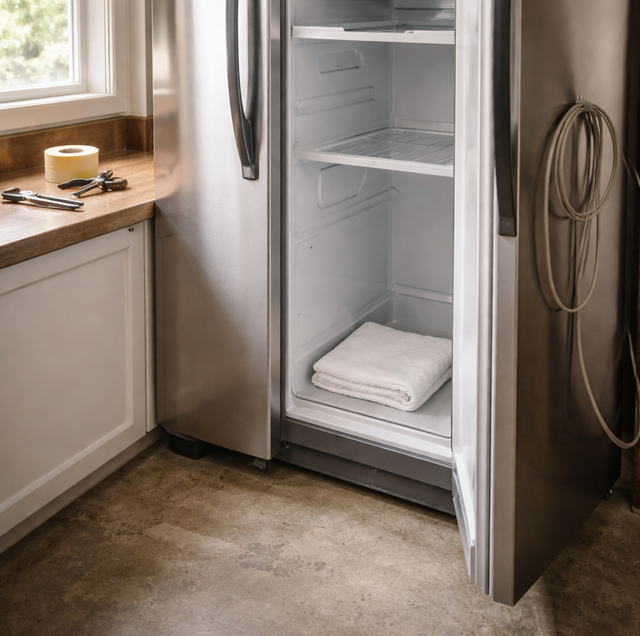
Drain and dry every surface: Empty the drip pan underneath, pour out any water reservoir, and wipe the interior, gaskets, and door channels dry. Water trapped in a sealed box is the number one cause of that closed-up mildew smell. Leave a folded towel inside to catch stragglers.
Secure the cord and keep it upright: Coil the power cord and tape it to the back or side so no one steps on it or trips. Tape the doors shut with a low-tack painter's tape that will not pull the finish. Most important, keep the refrigerator upright the entire move. Laying it flat lets compressor oil run into the cooling lines.
Let it settle before plugging in: At the new home, stand the fridge upright in its spot and wait before powering on. Several hours is a safe minimum, and a full day is better if the unit rode any distance tilted. This lets the oil return to the compressor. Powering up too soon is a common way to shorten a compressor's life.
Keep the refrigerator upright for the whole move, then let it stand in place at the new home for several hours before plugging it in, and a full day if it rode any distance tilted. That pause lets the compressor oil drain back where it belongs, so the unit is not run with oil still sitting in the cooling lines.
Washing Machine
The washer hides two problems: leftover water and a free-swinging drum.
Disconnect and drain the hoses: Turn off the hot and cold supply valves, then disconnect the fill hoses. Have a bucket and towels ready, because both the hoses and the machine's internal pump hold water that will run out. Run a short spin cycle beforehand to clear the pump, then disconnect the drain hose and let it empty completely.
Lock the drum with transit bolts: This is the step people skip and regret. Front-load washers ship with shipping bolts, also called transit or shipping rods, that thread into the back panel and lock the drum against the suspension so it cannot swing. If you saved them at delivery, reinstall them now. If not, the manufacturer sells replacements for your model, and it is worth ordering them before the move. Without the bolts, road vibration can wreck the shock absorbers and springs. Coil the hoses inside the drum or bag them so they do not get lost.
Clothes Dryer
An electric dryer is simple. A gas dryer is not a DIY job.
Clean it and disconnect the duct: Pull the dryer out, unplug it, and disconnect the vent duct from the back. Clean the lint trap and, while you have access, clear lint from the duct connection. Lint packed in the vent is a fire risk you do not want to carry to a new home.
A gas range or gas dryer connects to a fuel line, and disconnecting it belongs to a licensed professional or the gas utility, not the homeowner. A loosened or improperly capped gas fitting can leak, and a gas leak in a closed truck or a sealed house is a fire and explosion hazard. Schedule the disconnect ahead of moving day rather than treating it as a wrench-and-go task.
Dishwasher
A dishwasher is plumbed and wired in, so it needs both cut off.
Shut off water and power, then disconnect: Turn off the dishwasher's electrical circuit at the panel and close the water supply valve, usually under the adjacent sink. Disconnect the water supply line and the drain hose, keeping a towel underneath for the water that remains in the lines. Carefully ease the unit out from under the counter so the connections and any mounting brackets clear cleanly.
Dry it out to prevent odor: Wipe down the tub, the door seal, and the bottom sump area, and leave the door cracked so it can air out. A dishwasher holds standing water in its base, and sealed up damp for a move, it develops the same mildew problem a fridge does.
Gas Range, Doors, and Doorways
Three loose ends can turn a smooth move into a bad one.
Leave the gas range to a pro: A gas range connects to a fuel line and, in many setups, a shut-off valve behind the unit. Like the gas dryer, this disconnection belongs to a licensed professional or the utility, not the homeowner. Once it is safely disconnected and the line is capped, the range can be cleaned, the racks and grates removed and packed separately, and the unit prepped for lifting.
Secure every door and loose part: Any door that can swing is a hazard on stairs and a pinch point for fingers. Tape refrigerator and oven doors shut, remove or secure glass shelves and crisper drawers, and pack racks and removable trays separately so they do not rattle loose. Bag hardware and tape it to the machine it belongs to.
Measure doorways before moving day: Measure the appliance's width and depth, then measure every doorway, hall, and stair turn it has to pass through, at both homes. A refrigerator that will not clear the kitchen doorway is a problem you want to find days early, not with the truck idling outside. If clearance is tight, removing the appliance doors or the room door can buy the inch you need.
Frequently Asked Questions
The wait rule is about compressors, so it applies to the refrigerator, not the washer. A washer has no compressor to let settle. The real washer follow-up is to remove the transit bolts once it is in place, since the machine will bang loudly and error out if you try to run a spin cycle with the drum still locked.
For a short local move, pack the food tightly with the freezer running until the last moment, then transport it in coolers with ice or dry ice and reload fast at the new place. The appliance still needs to ride upright and get a settling period before you power it back on, so plan the cooler bridge to cover several hours minimum.
They are model-specific. The transit bolts are sized and threaded for your washer's rear ports and rest against spacers that hold the drum at the right position. A random bolt can be the wrong length and either fail to lock the drum or bottom out and damage the housing. Order the correct set for your model number if the originals are gone.
Shut off the small saddle or inline valve feeding the ice maker before you disconnect it, then blow or drain the remaining water from the copper or poly line so it does not drip. That thin supply line is easy to kink or snap, so coil it loosely and tape it to the back of the fridge rather than letting it dangle.
A refrigerator, freezer, or any compressor unit should stay upright. If it absolutely must tilt, keep the angle shallow and give it a full day standing upright before powering on. Washers and dryers tolerate being laid down better, but a front-load washer should still have its transit bolts in first so the drum does not shift against the tub.
Book the licensed professional or utility several days before moving day, and confirm the appointment window will finish before the crew arrives. Utilities can be booked out, and a same-day slot is not guaranteed. Handling the gas line early also gives time to reconnect properly at the new home rather than leaving a capped line unused overnight.
Get your appliances moved by a crew that preps them right — so they arrive dry, secure, and ready to run. Butterfield Moving serves Hillsboro, Beaverton, and the Portland area. Call (503) 867-2414.