
How to Label Moving Boxes: 7 Steps to Faster Unpacking
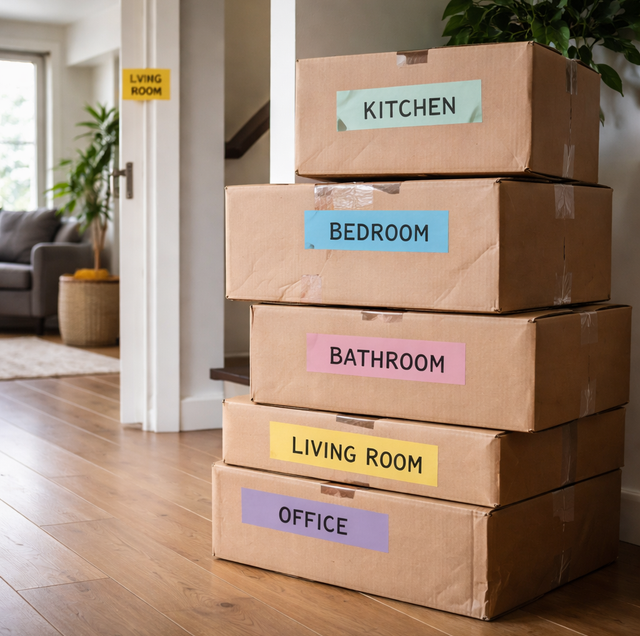
Quick Answer: Label the side of each box, not the top, so it stays readable when boxes are stacked. Write the destination room, a short contents list, and a priority level on every box, and add a color code with tape or stickers so the crew can sort by room at a glance. Number each box, keep a master list of what's inside each one, and mark FRAGILE and THIS SIDE UP where it applies. Set aside one "open first" essentials box, flag high-value and electronics for careful handling, and post a room sign on each doorway so movers set boxes down in the right place the first time.
Moving day gets all the attention, but the real time sink is the days after, when a stack of identical brown boxes hides everything you own. A good labeling system does its work on that end. It routes each box to the correct room before anyone opens it, tells you which boxes to open first, and lets you confirm nothing went missing between the truck and the front door. Spend a few extra seconds per box while packing, and you buy back hours on the other side.
Why Labeling Pays Off on the Unpacking End
A moving label is an instruction to your future, tired self and to the crew carrying the load. An unlabeled box is a piece of luggage riding an airport carousel with no name tag: it has to be opened, guessed at, and hauled a second time to wherever it actually belongs. That double-handling is where move-in day falls apart.
Three jobs make labeling worth it. First, routing: a box marked for the kitchen goes straight to the kitchen, so you're not shifting a wardrobe box out of the dining room later. Second, prioritizing: a labeled priority tells you what to open tonight versus what can wait a week in the garage. Third, tracking: a numbered box and a matching list let you count what came off the truck against what you packed, so a missing box gets noticed the same day instead of a month later.
Label the Side, Not the Top
The single most common mistake is writing on the top flap. Once boxes are stacked three or four high, every top label disappears. Write on at least two sides so the label faces out no matter how the box lands in the truck or the stack. Use a wide-tip permanent marker in a dark color, and print, don't cursive-scrawl, so a mover reading it in a dim hallway can act on it fast.
Keep the writing large enough to read from across a room. If you reuse boxes with old markings, cross the old text out completely or slap a fresh label over it, because a leftover "BOOKS" on a box now full of towels will send it to the wrong room.
Build a Room, Contents, and Priority System
A strong label answers three questions in three lines.
Room: Name the destination room, not the room it came from. "Master bath," "kids' room," "garage," or "office" tells the mover exactly where to set it down. Match these names to the ones you'll post on the doors later.
Contents: List two or three key items, not an inventory. "Pots, mixing bowls, dish towels" is enough to tell a full box from a fragile one and to find the coffee maker without opening five boxes.
Priority: Rank each box so you know the order to work through them. A simple three-tier scale works well: Priority 1 is open tonight, Priority 2 is within the first week, Priority 3 is no rush. That ranking is what turns a wall of boxes into a to-do list.
Add Color Coding You Can Read Across the Room
Words take a moment to read; color reads instantly. Assign one color to each room, then mark every box for that room with a strip of colored tape or a colored sticker on the same two sides as the writing. Blue for the kitchen, green for the primary bedroom, red for the office, and so on. Post the matching color on each doorway, and the crew can sort by eye without stopping to read a word.
Keep a small key taped inside your front door so everyone works from the same code. Colored painter's tape holds well on cardboard and peels off cleanly if you're reusing boxes. If you're mid-move and out of colored tape, a fat swipe of the matching marker color in the top corner of the label does the same job.
Number Every Box and Keep a Master List
Color and room names get a box to the right room. Numbering protects you against loss. Give every box a unique number, then keep a master inventory list, on paper or your phone, where each number gets a line: the room, a fuller contents note, and a check-box for "arrived."
The list earns its place in three ways. You can count boxes off the truck against it and catch a missing number before the crew drives away. You can find a specific item, say the router or the good knives, by searching the list instead of opening boxes. And if a box is delayed or lost, the list is your record of what was in it. Write "1 of 34" style totals on the boxes too, so anyone can see at a glance whether the count is complete.
Mark Fragile and This Side Up Correctly
FRAGILE and THIS SIDE UP only help if they're placed where a mover looks. Write FRAGILE on all four sides and the top so it can't be missed, and draw an up-arrow with THIS SIDE UP on boxes holding stemware, framed art, or electronics that must stay upright.
Labels are not padding, so back them up with the pack itself. Set heavy items on the bottom and lighter, fragile items on top, fill every gap so nothing shifts, and cushion plates by standing them on edge rather than stacking them flat. A box marked fragile that rattles when lifted will still break, label or not.
Pack and Flag an "Open First" Essentials Box
Set aside one box, or one per person, that you label clearly as the essentials or "open first" box and load last so it comes off the truck first. Fill it with what you need for the first night and morning: phone chargers, a change of clothes, toiletries, medications, basic tools, paper towels, trash bags, toilet paper, snacks, and the coffee setup. Give it its own bold color or a big star so it never disappears into the stack.
This one box is what lets you stop for the night without tearing open ten others to find a toothbrush. Keep truly irreplaceable items, passports, cash, jewelry, key medications, with you in the car rather than on the truck at all.
Handle High-Value Items and Electronics with Care
Electronics and valuables need labels that guide handling without advertising what's inside to strangers. On the box, mark the handling need, "FRAGILE, THIS SIDE UP, electronics," and use a discreet code on your master list rather than writing "TV" or "jewelry" in large letters on the outside.
Before you unplug a TV, monitor, or router, photograph the cable connections on the back so you can rewire it correctly at the new place. Then bag and label each cord, and keep remotes and small parts in a labeled zip bag taped inside the same box.
Keep Boxes Liftable and Don't Over-Pack: Labels won't save a box that's too heavy to carry safely. Put heavy, dense items like books, tools, and canned goods in small boxes, and save the big boxes for light, bulky things like bedding and pillows. A packed box should be liftable by one person without straining, roughly what you'd carry up a flight of stairs without setting it down. Don't fill a box past the point where the top folds close flat: an overstuffed box that won't seal loses its stacking strength and can burst mid-carry. If a box feels borderline, repack the load into two.
Post a Room Sign on Every Doorway
Your labeling system only works if the crew knows which room is which. Before the truck arrives, tape a sign on each doorway at the new place: the room name and its color code in big letters, "KITCHEN, BLUE." Movers reading a blue label carry it to the blue door without asking, and the guesswork that clogs a hallway with mis-set boxes disappears.
Post a copy of your color key by the entrance too, and walk the crew through it in thirty seconds before they start. That short briefing is what connects the labels on the boxes to the signs on the doors, and it's the difference between a crew that flows and one that stops to ask about every box.
Frequently Asked Questions
Label each box the moment you seal it, not in a batch at the end. Writing the contents while the box is still open and in front of you is far more accurate than trying to recall what went into 30 sealed boxes the night before the move. Packing in reverse order helps too: start with the rooms you use least, like a guest room or storage closet, weeks ahead, and leave daily-use rooms for the final days.
Add a fourth line for destination: "HOME" or "STORAGE," so the crew splits the load correctly at the truck. For anything going into storage, face all labels toward the aisle when you stack the unit, and leave a walking gap down the middle so you can reach a back box without unstacking the whole unit. A stored box you can't see the label on is a box you'll have to open blind later.
For a long-distance or multi-day move, add your name and the delivery address to each box, since your shipment may sit alongside other households on a shared truck. The numbered master list matters even more on a long move: with a longer transit and more handoffs, the box count is your main defense against a carton that gets set off at the wrong stop.
Many crews work off a numbered-inventory system and tag each item with a colored sticker keyed to a written list, the same logic as a coat-check ticket. If your mover uses their own numbered tags, keep your master list compatible by recording their tag number next to yours, so one lookup finds the box in either system rather than forcing you to reconcile two.
Use painter's tape and a marker directly on the item, or tie a labeled tag to it, and note its destination room and color the same way you would a box. Bag the screws and small hardware from anything you disassemble, label the bag with what it belongs to, and tape it to the underside of that piece so the parts travel with the furniture instead of ending up in a mystery bag of loose bolts.
The costliest one is unlabeled or vaguely labeled boxes, "misc" or "stuff," which get set down anywhere and have to be opened one by one. Running out of a color mid-move and switching schemes halfway is a close second, because half the load stops matching the door signs. Decide your full color key and buy enough tape before you pack the first box, and keep a spare marker in your pocket so a box never gets sealed unlabeled because the pen wandered off.
Get a crew that reads your labels and sets every box in the right room — less lifting, faster settling in. Butterfield Moving LLC serves Hillsboro, Beaverton, and Portland. Call (503) 867-2414.